I already paid for Codex, Gemini, and Claude. I wanted one place to give them work, let them challenge each other, and bring back something I could actually trust, without spending my day as the human API between three chat windows.
I built TeamLoop with Codex to do that from one conversation. The tests on this page helped decide which model should build, review, investigate, or stay out of a particular job.
One conversationIndependent criticsEvidence before trust
Quick reality check: this is one practitioner’s structured experiment using synthetic tasks, isolated runs, browser checks, blind scoring, and every failure I could preserve. It is not a scientific benchmark, an employer evaluation, or a universal model ranking. This was my personal experiment, not an official Glean benchmark.
THE USEFUL RESULT WAS A ROUTERBEAUTIFUL IS NOT THE SAME AS WORKINGEVERY FAILURE SOLD SEPARATELYPLEASE VERIFY YOUR INTERFACES
The actual purpose
I was trying to build a useful team
My subscriptions gave me access to a lot of capability, spread across separate apps and usage limits. I wanted Codex to coordinate that capability while I kept one conversation. Spending my weekends testing models was how I worked out the assignments. It was not supposed to become the entire personality of this project.
Where the idea came from:Claudex Loop got me thinking about having Claude and Codex challenge each other's work. I wanted to bring Gemini into that loop, then add smaller and specialized models when they earned a place. So I built a separate system with Codex: TeamLoop. Claudex Loop supplied the starting workflow idea. TeamLoop has its own runners, context handling, routing rules, and verification.
Speed where it helps
Independent reviews can run alongside each other. A fast model can handle a bounded draft while the lead works elsewhere. The handoff has to earn its time back; adding another model can also make a small job slower. If all I added was coordination, I invented a meeting.
More range for bigger work
I can bring different strengths to one project: implementation, design direction, deep architecture, or a fresh attempt to break the idea. A demanding job can get a stronger specialist and more time.
Verification built in
The builder gets another set of eyes. Then Codex checks the criticism against the brief, the source, and actual tests. Browser checks, calculations, and reproducible failures carry more weight than confident agreement. Two models confidently agreeing is still not a test.
Spend context carefully
Tokens are the chunks of material a model reads and writes. Local tools can extract relevant content and summarize passing checks before a model reads it. Specialists get the selected evidence and assignment, so expensive context goes toward the difficult part.
Use the capacity I pay for
Suitable jobs can use the allowances attached to my different subscriptions. That gives me more options when one is tight. Each provider still has its own limits, and optional API models have their own access and billing rules.
One conversation to manage
I explain the job in Codex. The lead chooses the useful workers, passes context, and brings the findings back. I keep the desktop interface and the decision, without becoming the person copying the same brief into three chat windows.
And yes, I get to red-team everything. A plan, a design, an explanation, an architecture, a finished build. Red-teaming means deliberately asking where it breaks, what it assumes, and what the builder missed. TeamLoop makes that a repeatable part of the work. The depth matches the stakes: routine checks can stay with Codex, while consequential work gets an independent critic or a wider review.
The tests gave these assignments an evidence base. They also showed me where delegation was fragile, where a specialist helped, and where the handoff was more trouble than it was worth.
These are the operating benefits the system is designed to pursue. The field study informs task fit and verification choices; it does not establish a universal speedup or a fixed percentage of tokens saved.
The question I should have answered first
Okay, but what software is TeamLoop?
A friend asked me this several times before I realized I had explained nearly everything except what the software actually was. Fair criticism. Here is the actual answer.
TeamLoop is a custom orchestration harness running on my Windows computer. It consists of a Codex skill, JavaScript programs run by Node.js, JSON routing rules, typed execution plans, and local files that preserve context and results. I operate it through the Codex desktop app.
A harness is the code and rules around the models that organize their work. Node.js is the program that executes the JavaScript outside a web browser. My computer runs the coordination software; the selected AI models run in their providers' clouds.
01 / One conversation
I give Codex a job
The lead works out the requirements, chooses the useful specialists, and tells me who is doing what.
02 / Local execution
Code freezes the plan and handoff
A typed plan records dependencies, failure rules, and the concurrency cap. Local tools prepare the selected evidence.
03 / Selected workers
Models return recorded work
The runner starts only typed review stages, reaches the selected providers, and records each stage lifecycle. The lead only starts the routes the job needs.
04 / Back in Codex
The lead verifies and integrates
Results and logs come back to local files. Codex checks findings, applies accepted changes, and returns the answer and artifacts in our conversation.
The skill is the operating manual
A Markdown instruction file tells Codex how to scope work, choose roles, pass context, and handle disagreement. The file does not execute anything by itself. Codex reads it and uses its tools to carry out the workflow.
The runner is an actual program
It launches the selected command-line tool, sends the assignment, waits for output, enforces a time limit, and saves the response or failure. Think of it as the part that turns “ask Claude to review this” into a real, recorded job.
The routing rules are structured settings
JSON files describe roles, model choices, review budgets, and allowed tool routes. Codex interprets my request; a local JavaScript router applies these rules. The rule lookup itself does not need another model call.
The execution plan is a contract
A strict JSON plan says which review stages exist, what they depend on, whether a failure blocks later work, and how much can run at once. It cannot contain shell commands or invent a new kind of task.
The context and memory are local records
Selected evidence is saved as a versioned task packet. Outputs and run status live in folders; accepted facts and decisions go into Markdown notes. Codex owns the updates and sends a fresh packet when the source changes.
The runners do not synchronize three shared brains. Each worker gets an explicit assignment and selected evidence. It does not automatically see the other models' chats or the whole Codex conversation. Keeping the context consistent is part of the lead's job.
The current TeamLoop core has no database server, MCP server, or separate hosted dashboard. It is skill instructions plus executable local code and files. It lives outside the repository being worked on, so the same system can help across projects. This website explains the system; it does not run the orchestration.
The actual stack, for the friend who keeps asking
Interface and lead: Codex desktop. Codex invokes local commands through its execution tools and can start tool-enabled Codex workers for building and production work.
Local runtime: Node.js 22 or later. The review runner uses Node's built-in modules and has no npm package dependencies of its own. The provider programs and optional preparation tools are separate installed software.
Instruction and routing layer:SKILL.md, route-team.mjs, and JSON policies describing model roles, tools, and execution targets.
Review execution:team-loop.mjs starts subprocesses such as claude -p, the Antigravity CLI, or codex exec. Provider adapters translate the same assignment into each program's expected format. Optional NVIDIA reviewers use an explicitly selected API route.
Files on disk:config.json selects installed executables and the state folder. state/packets holds task snapshots; state/runs holds individual review results; state/plan-runs holds plan snapshots, status, and lifecycle events. CONTEXT.md and DECISIONS.md preserve accepted task knowledge.
Execution controls: packets are fingerprinted so changed inputs can be detected. Plans validate dependencies, distinguish required from advisory failures, cap concurrent work at three stages, and keep one active review per provider. The runner checks response format, task identity, elapsed time, and completion status. Review workers have tool restrictions; the lead owns changes to the working project.
Subscription access: the core routes use supported account-login paths in the installed provider programs. A paid chat subscription does not automatically include arbitrary API usage. TeamLoop keeps API routes explicit and does not silently switch to paid overflow when a subscription is exhausted.
Current limits: run logs track this system's activity, but there is no unified live dashboard of every provider's remaining quota. Some native app capabilities need separate handling; the current Gemini headless review adapter accepts text, not native video. The local runner works when invoked and needs a running computer. It is not an always-on cloud service.
Implementation described from the installed skill, routing script, provider adapters, and local record layout inspected on September 21, 2026. Provider access and available models can change.
TeamLoop Live / The Dream Machine
Then I gave the team faces
Run logs are great after the fact. I wanted one glance to tell me who is working, who is stuck, and who is waiting on me. So every agent session on my computer now shows up as a little 8-bit character, working away in a pixel-art arcade.
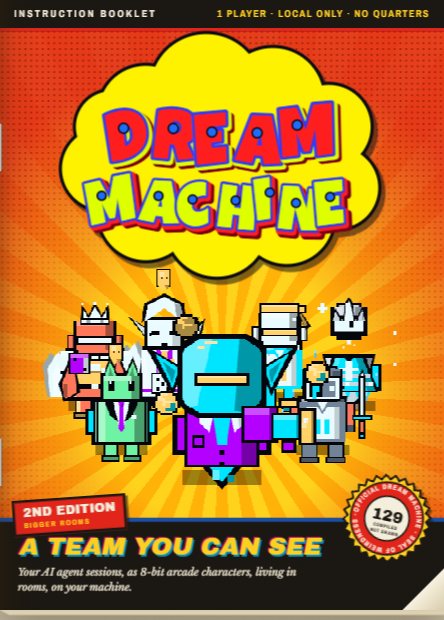
The Dream Machine is TeamLoop Live: a local, read-only display of my own agent sessions. Codex tasks, Claude Code sessions and TeamLoop reviewers each get a procedurally drawn 8-bit character, and each crew gets its own arcade room.
There are no sprite files. Every character compiles from a DNA recipe, a short list of traits that code turns into pixels. There are 129 recipes and 125 public characters, and any name you type compiles into a brand new one. Same name, same character, every time.
Research, build, test, design pass, red team. Under the label: one line for right now and short lines for each turn, like “Edited 3 files.” All of it comes from records the tools already keep. Zero model calls.
Claude Code moved in
Claude Code sessions and their helpers now show up beside Codex tasks and TeamLoop reviewers.
Reviewers sit with their lead
Each TeamLoop reviewer works in the room of the lead that sent it, so you can tell whose question it is answering.
Two ways to look
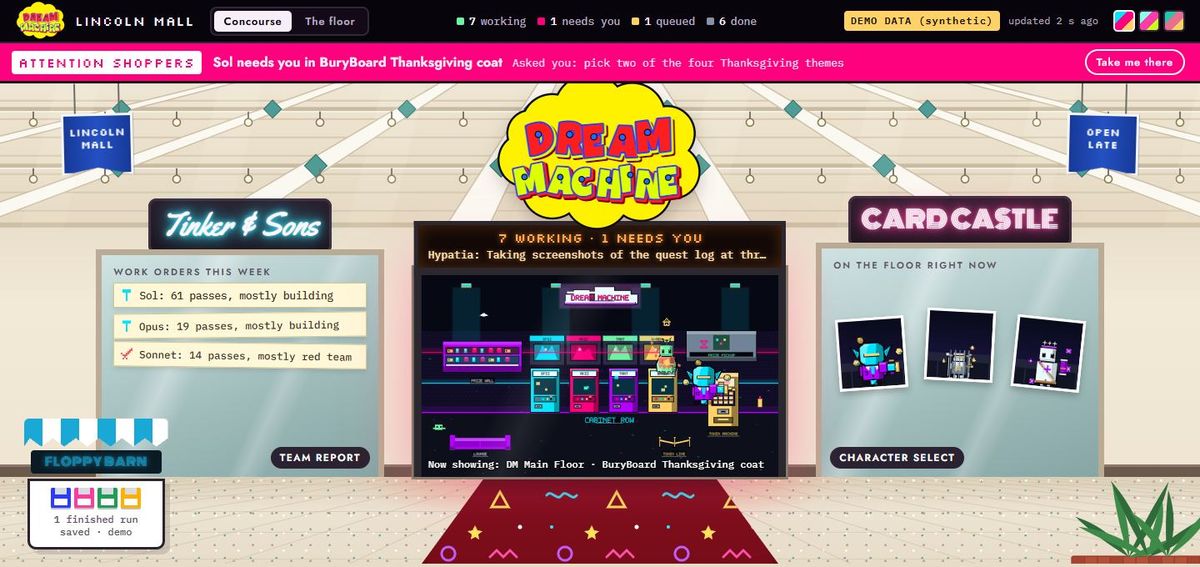
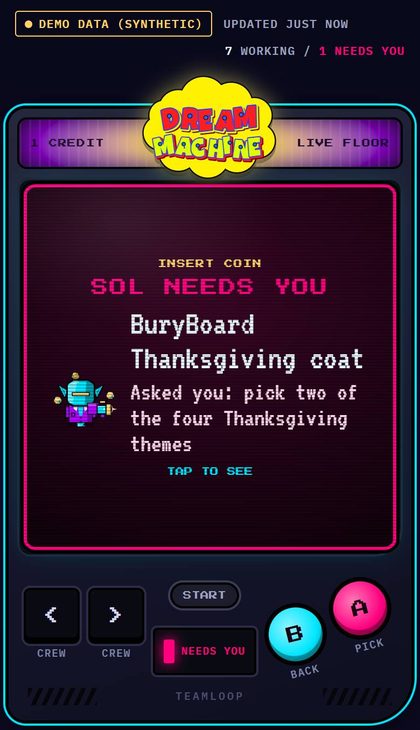
On a desktop it is an arcade inside Lincoln Mall. On a phone it is an Attract Mode arcade cabinet.
A second edition of the Manual
October 22: every room rebuilt bigger and more detailed, with room for 34 characters each. The cabinets play their own games, five label styles keep a crowded floor readable, and the code chapter now ships the rooms and a one-file starter.
Open source on GitHub
Also October 22: the drawing engine, the rooms, the one-file starter and the Manual itself are on GitHub at thebeefasaurusrex/dream-machine, under Apache 2.0. The live app that reads my sessions stays on my computer.
Boundary: this is a local display of my own sessions, on my own computer. It reads records the tools already write, makes no model calls and changes nothing. It is not part of the portable TeamLoop toolkit, and it is not a hosted dashboard. Both screenshots below use synthetic demo data and show the first edition rooms.
Desktop / Lincoln Mall arcadePhone / Attract Mode cabinet
The roster right now
Different jobs. One adult in the room.
The benchmark chapters below are frozen records of what happened. This is the living part: the current TeamLoop assignment map after the latest evidence.
Roster v1.14.0Effective October 28, 2026Codex owns the final call
Core production
Lead / judge
GPT-6.1 Sol Medium
The operator-selected Codex lead: scopes, owns context, implements, integrates, verifies and adjudicates. Handles evidence preparation and the predeclared subscription availability fallback. GPT-6 Sol is removed from active routing by operator decision; historical results remain unchanged. Other specialists stay task-selected.
Flagship production
GPT-6 Astra
Tool-enabled multimodal production, ambitious web builds, asset research, and difficult end-to-end work. Used after cheaper tools prepare the evidence because this thing eats well.
Sustained builder
GPT-6.1 Terra Medium
The active bounded builder uses the exact gpt-6.1-terra pin at Medium for operational tools, customer-facing interfaces and scoped implementation. 6.1 Sol remains lead and verifier. Two matching text smokes do not replace historical GPT-5.6 Terra grades; included subscription savings remain unverified.
Variant builder
Codex Luna
Exploratory drafts and bounded alternatives under explicit acceptance criteria. Useful breadth, followed by lead-owned QA.
Selected design owner
Opus 5.5 High
Ambitious interface/design work in an isolated worktree, with selected-file Read/Write/Edit, incremental saves, a small final receipt and the full 45-minute allowance. GPT-6.1 Sol owns scope, browser QA, integration and promotion. No automatic fallback.
Independent critics and specialists
Human-facing critic
Claude Sonnet 5.5 High
Pinned independent critique for language, requirements, accessibility, design coherence and selected complex synthesis. GPT-6.1 Sol verifies findings and retains final authority.
Scarce escalation
Claude Opus 5.5 High
Pinned rare architecture, product vision and editorial synthesis. Selected design ownership uses the separate durable-file design lane, not a whole-HTML reviewer response.
Coverage auditor
Gemini Flash High
Completeness, edge states and evidence synthesis. Native subscription video is preferred only when its transport is separately verified; the text-only headless runner does not watch footage.
Rapid explorer
Gemini Flash Medium
Disposable breadth, alternative directions, and fast first passes. Cheap enough to explore, never exempt from verification.
Engineering auditor
DeepSeek V4.1 Flash
Public or synthetic source-heavy engineering review, lifecycle and concurrency analysis, and architecture-versus-implementation checks. High is the default. Codex verifies every claim.
Reserve bench and wildcards
Atomic reserve
GPT-5.3-Codex-Spark
One bounded patch with a fixed test and cheap restart. It is not an automatic route and should not inherit a whole build halfway through.
Visual wildcard
Muse
Interesting direction reconstruction, but not reliable enough for production visual judgment. Available for a genuinely different tie-breaker.
Systems wildcard
Nemotron 3 Ultra
A different model family for rare architecture disputes. The tested delivery did not earn a normal lane.
Unavailable or removed
GLM-5.2 and Kimi
The tested GLM endpoint was retired. Scripted Kimi subscription use remains blocked pending provider permission; this is an automation boundary, not a model-quality judgment.
User-selected candidate
Claude Fable 5.1
Experimental creative comparison only when explicitly selected. Its pinned identity must match and subscription access must work with usage credits off. No retry or substitution. Local guard tests passed; creative quality and provider availability remain unproven.
Tools are part of the team without pretending to be models. Local scripts extract, convert, diff, lint, test, and package evidence first. The Forge Worker handles private local preparation when appropriate. A model only gets work that still requires judgment.
Availability is a route condition, not a philosophical crisis. If a specialist is unavailable, the job returns to Sol or a named fallback. TeamLoop never silently swaps in paid API usage or sends private material to an external specialist.
Separate matched workflow / October 28, 2026
Both delivered. Opus kept the evidence honest.
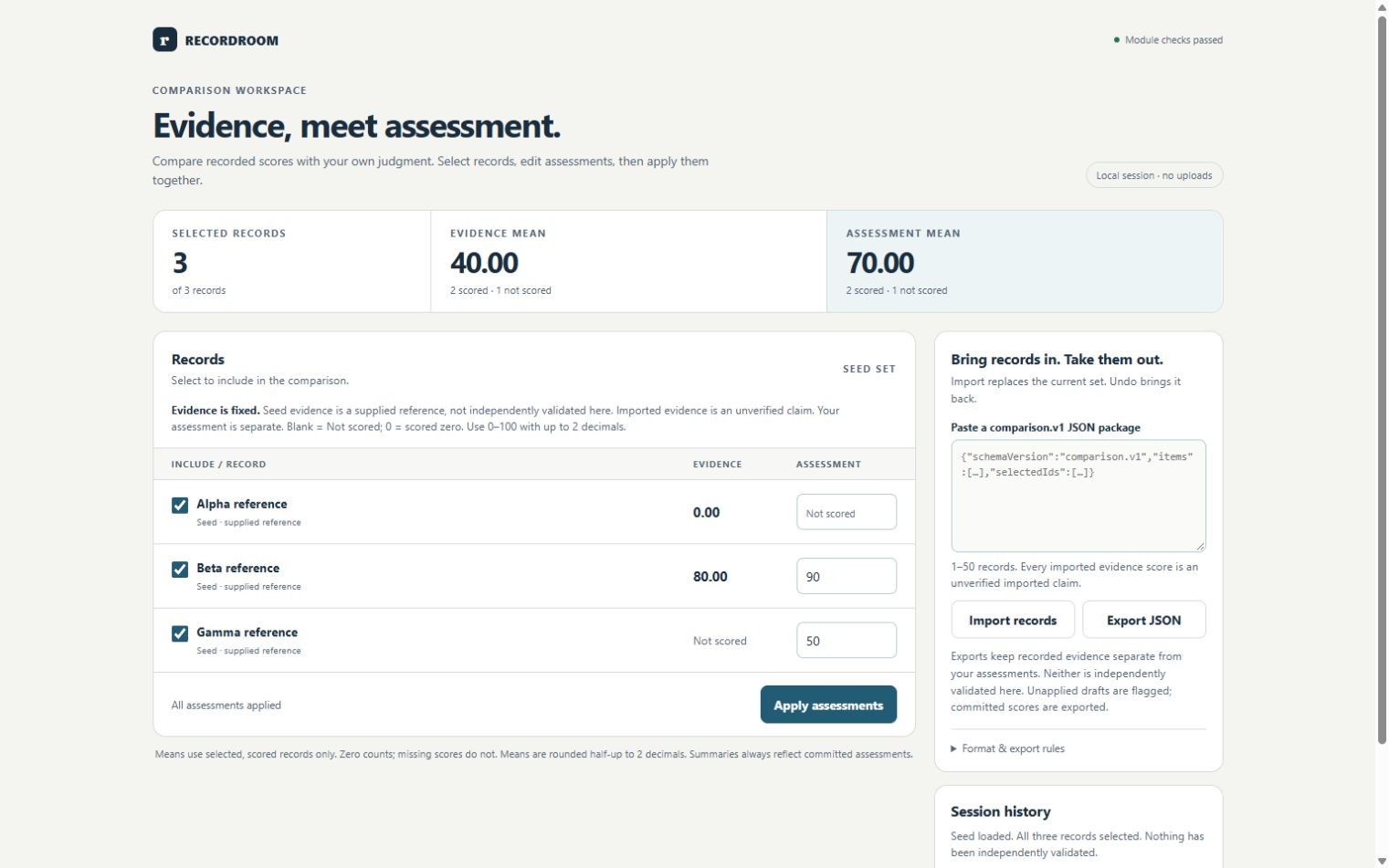
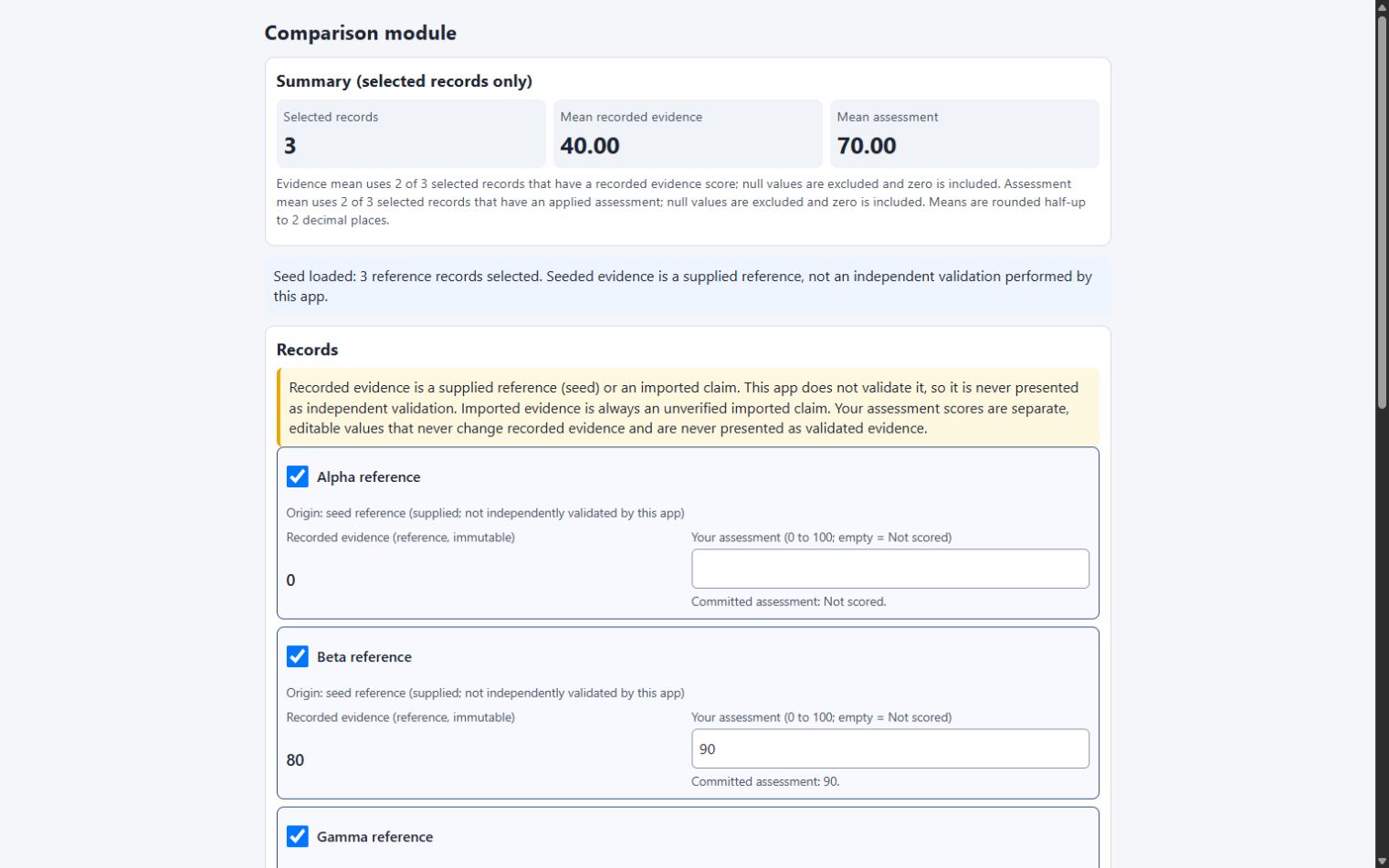
Opus 5.5 High scored 91/100; Argon Medium scored 69/100 on the original model-comparison console brief. Both completed through the same constrained host file-action contract. Opus was better at evidence-based decision support; Argon invented audit details and left score-bound and verdict-label defects. This new workflow does not replace the historical one-shot grades or promote Argon to default design work.
The original brief, seed data and six-category rubric stayed fixed. Each primary had 45 minutes total, up to 32 intentional host turns and four selected Read/Write/Edit actions per turn. Native calls used the remaining total deadline; the host replayed the complete action/result transcript. There was no native operational tool, Compute, OS, network, browser, MCP, delegation or adaptive lead QA feedback. This is explicit host orchestration, not CLI session continuity or a shipped automatic production route. Native effort labels are not equal compute.
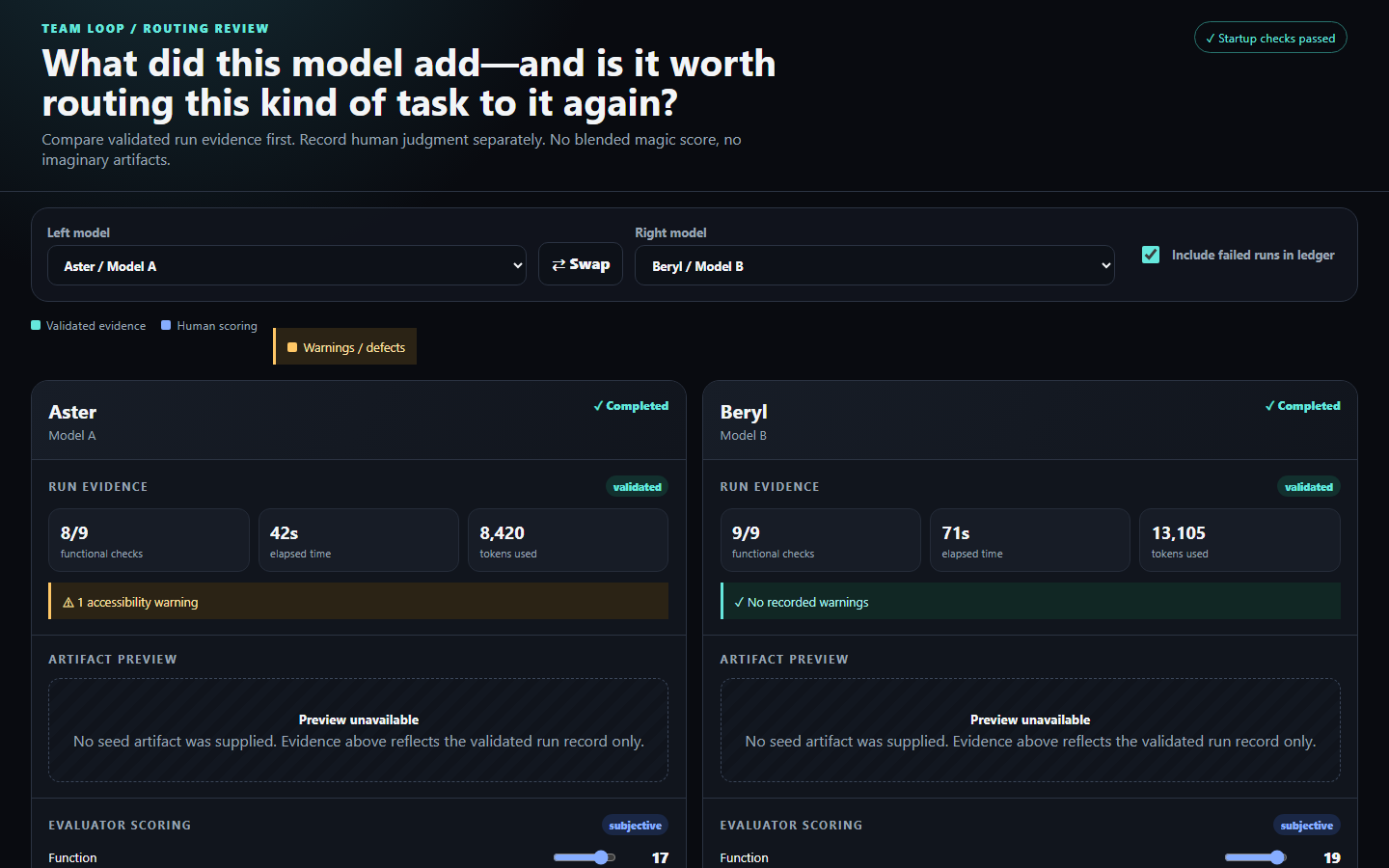
The quality difference: Opus says missing evidence details were not supplied. Argon invents validated gate logs, a specific accessibility finding and a category breakdown absent from the brief. Its verdict labels still name the original pair after selection changes. After the score lock, root confirmed that five inputs of 100 display 500 / 100 without invalid flags; the locked 69 was unchanged. Opus's invalid numeric draft remained a smaller clarity issue. Scores used the original 30/20/15/15/10/10 rubric, random artifact IDs and a lock before identity join, with source-backed lead adjudication. Download both category-score rows.
What was actually checked: startup, fictional failed-candidate exclusion, live score/evidence separation, filtering, an Enter-key swap with notes/assessment association, and comparison changes worked in the observed flows. Viewport checks reported no horizontal page overflow at 1440x900 and 390x844. Both apps reported a download, but actual downloaded JSON contents remain unverified after browser observation limits; no blocked URL was bypassed. Full keyboard, screen-reader and cross-browser coverage remain unverified. A working core is not a blanket browser pass.
Why the infrastructure history still matters
Zero-call setup refusals, an Argon diagnostic-preview comparison bug and an Opus passive-metadata observer abort remain separate infrastructure records. Argon later encountered a real transient audit-file double-link and a concurrent host-check race. Narrow study-local physical-audit, FIFO and drain corrections passed 37 offline tests plus 100 synthetic writes with concurrent checks. Its original complete actions were mechanically replayed without quality regeneration or QA feedback. The original 45-minute clock included host-repair downtime, and Argon completed before that original deadline. Guards were not weakened. One Opus observer-abort call has unknown final usage and is outside the accepted-primary count; replayed Argon source calls are counted once. Wall-clock speed ranking across these interruptions would mislead.
Claude's rounded session meter moved 9% to 12%, with weekly usage unchanged at 38%; those shared meters and provider token counts do not establish normalized quota cost, dollars billed or subscription savings. Policy 1.14.0, active Terra 6.1, 6.1 Sol as lead and the pinned Opus/Sonnet roles remain unchanged. Existing Argon review consideration does not become default design ownership. Full method and evidence record.
Two unchanged synthetic outputs
Use synthetic inputs only. These original artifacts preserve the observed defects. Neither is a production tool, and downloaded-file contents remain unverified for both.
Completed; limited browser QA91 / 100
Opus 5.5 High
Evidence-first comparison
Core observed controls worked and missing audit details stay explicitly unknown. An invalid numeric draft remains a clarity issue. No exhaustive accessibility or actual export-file verification is claimed.
Invented audit details, unsupported category decomposition, stale verdict labels and a 500/100 score-bound defect remain visible. These were not repaired or hidden before publication.
One practical configuration per contender, one task and AI-assisted scores are field evidence, not a universal model ranking. This was my personal experiment, not an official Glean benchmark.
Accepted operating change / October 28, 2026
Terra moves to 6.1. Sol still runs the team.
Active bounded Terra work now selects GPT-6.1 Terra Medium under policy 1.14.0. GPT-6.1 Sol Medium remains lead. The operator accepted this version swap with included subscription savings explicitly unverified. Pinned Opus 5.5 design/architecture and Sonnet 5.5 critique roles stay unchanged.
Requested configuration
Matched text smoke
Elapsed
GPT-5.6 Terra Medium
Same two seeded defects; correct minimal recommendations
9.134s
GPT-6.1 Terra Medium
Same two seeded defects; correct minimal recommendations
6.656s
Both October 27 calls used the same small tool-free source packet and 90-second deadline. Exact requested pins were recorded, but the backend did not separately return an actual model identity. Two observations establish a small compatible path, not broad quality improvement, a latency distribution, or tested image/computer-use capability. Historical GPT-5.6 Terra scores, dated comparisons and example apps remain labeled as originally tested.
Credit prices are not a subscription-saving measurement. The official Standard credit rates, checked October 28, are 50 / 5 / 300 credits per million input / cached-input / output tokens for 5.6 Terra, versus 25 / 1.25 / 125 for 6.1 Terra. Lower equal-token credit rates do not prove the same change in included subscription usage. The rounded weekly meter stayed at 50% before and after each tiny call and cannot resolve either call or establish a saving ratio. No purchase, overflow or paid API fallback was used.
What changes operationally: active local model selections and bounded-builder routing use gpt-6.1-terra at Medium; 6.1 Sol still scopes, integrates and verifies. The portable toolkit resolves the adopter's explicit provider/model configuration and does not install personal defaults. Dated change record and operating snapshot. Unfinished Argon/Opus design work is outside this update.
The part worth stealing
The ranking was the least interesting result
Once TeamLoop had a purpose, I needed evidence for its assignments. Raw capability mattered, obviously, but task fit, clean delivery, verification cost, and whether I could recover from a failure mattered just as much. Here is what the testing changed.
01 / No universal winner
There was no king of the hill
The strongest default builder was not always the strongest architect, critic, visual thinker, or fast source of alternatives. Once I looked at the work instead of the logos, routing by task made way more sense than crowning one brand.
02 / Reliability changes the picture
A gorgeous survivor can lie to you
A model can make exceptional work when it finishes and still be a rough operational default. The picture changed as soon as failed attempts and broken browser behavior counted too.
03 / The harness counts
Sometimes the harness ate the homework
Timeouts, wrapper failures, transport limits, and context exhaustion can all look like model weakness. I kept those failures and separated the model, provider, harness, and verification problems when the evidence allowed it.
04 / Confidence is not a test
If I didn’t click it, it didn’t count
Several interfaces looked polished and still had dead controls, runtime exceptions, or resets that did not actually reset. Browser checks caught things the screenshots and very confident prose did not.
The full evidence trail
Every test that changed the team
I did not pour every result into one cursed leaderboard. Each study answered a narrower routing question and kept its own date, conditions, failures, and limits.
Same brief. Isolated run. Then I clicked everything.
Every comparison started with the same bounded brief. I isolated the runs, scored them against written criteria, and checked the finished work in a real browser. If something needed repair or salvage, I recorded that instead of quietly swapping in the fixed version and pretending we nailed it the first time.
01Freeze the brief
02Run in isolation
03Verify behavior
04Score blind
05Update routing
Dated studies, separate contracts
Short functional builds established a baseline. Deep-end builds tested ceiling. Corrected assisted runs tested repair. Specialist, Spark, and DeepSeek placements tested narrowly claimed jobs.
Two ways to read a score
Completed-work quality asks, “How good was it when it came back?” Reliability-adjusted value asks, “What did I actually get from every run I scheduled?” I need both answers. They are not interchangeable.
Historical cohorts: one human judge
For the original September cohorts, models made artifacts and contributed critique, but they did not vote on the winner. I made the final calls from the requirements, evidence, and browser results. The October 24-25 replay below uses separately labeled AI-assisted masked scoring; I have not personally scored it.
What “blind” meant
I shuffled completed artifacts behind random IDs. The scoring view showed the task, screenshots, browser evidence, and blind ID, but not the provider or model. I did not open the identity map until the score file was written.
What I could not see
The scoring interface hid model names, provider labels, aggregate results, and every other model’s score. Every artifact inside a task set used the same frozen rubric.
What happened to failures
Incomplete attempts never entered the blind gallery. Their runner status already existed before scoring, and I classified the failure from logs afterward. A timeout means no artifact was scored. It does not mean the model’s ideas were bad.
What I can show publicly: the task summaries, rubric weights, formulas, dates, attempt outcomes, browser results, and failure attribution are all here. I also published original synthetic artifacts below, including one known broken build. Raw local logs, private prompts, and artifacts that use project-specific branding remain out of this public edition. You can reconstruct the operational math from this page. The visual scores are still one person’s judgment.
No mystery tasks
What I actually asked them to build
Every configuration inside a task set got the same self-contained brief, seed data, observable hooks, and delivery constraints. These summaries include the central question and what success had to look like without publishing unrelated implementation artifacts.
Adoption operations
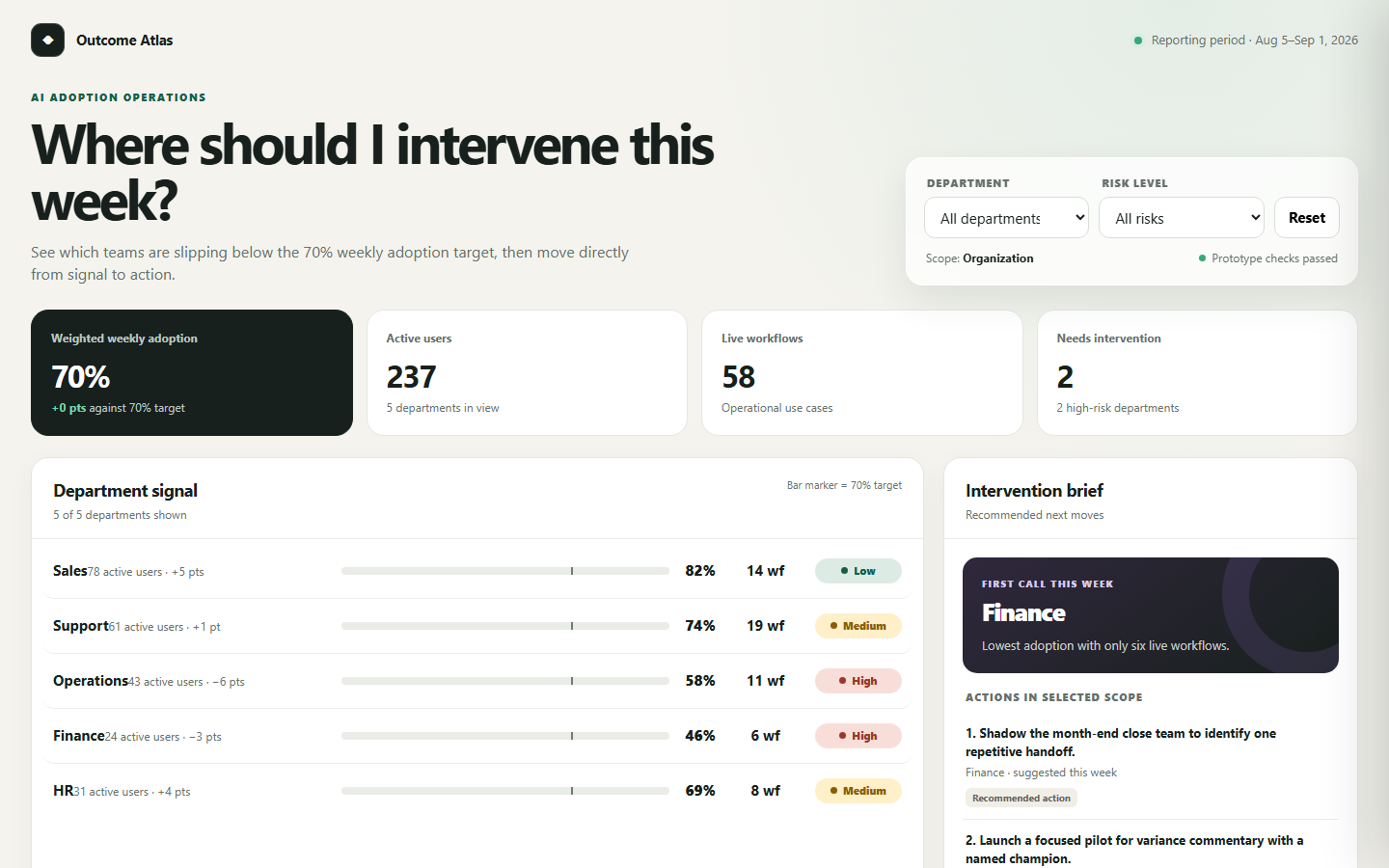
Question: Where should an AI adoption lead intervene this week?
Five seeded departments with adoption, workflow, and risk data
Department and risk filters, accessible detail view, recommendations, reset, startup self-check
Responsive at 1440×900 and 390×844; inline HTML, CSS, and JavaScript only
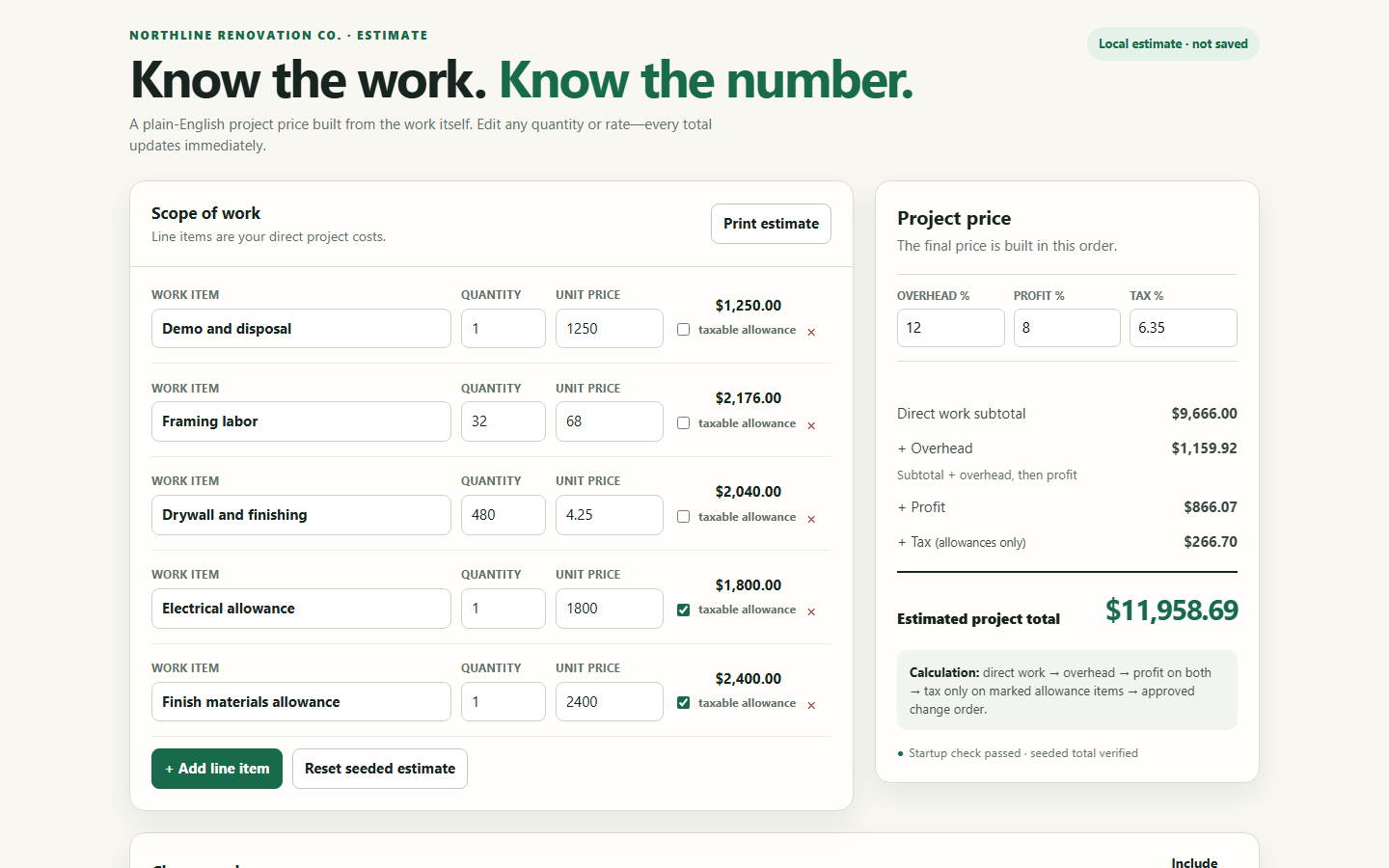
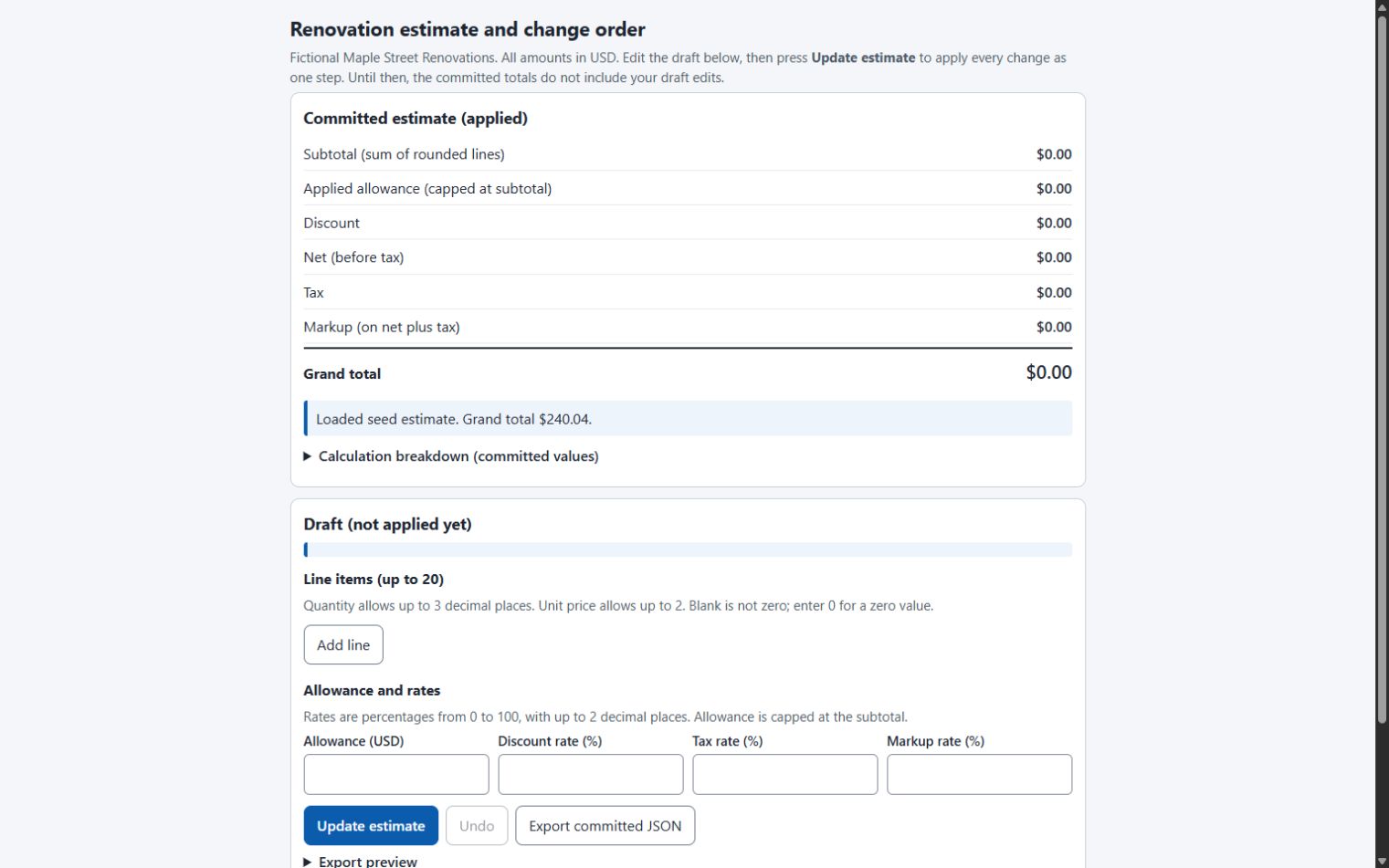
Transactional estimator
Question: What is the customer paying for, and what changed?
Seeded line items and explicit overhead, profit, and selective-tax rules
Outputs explicitly framed as a thought experiment, not empirical prediction
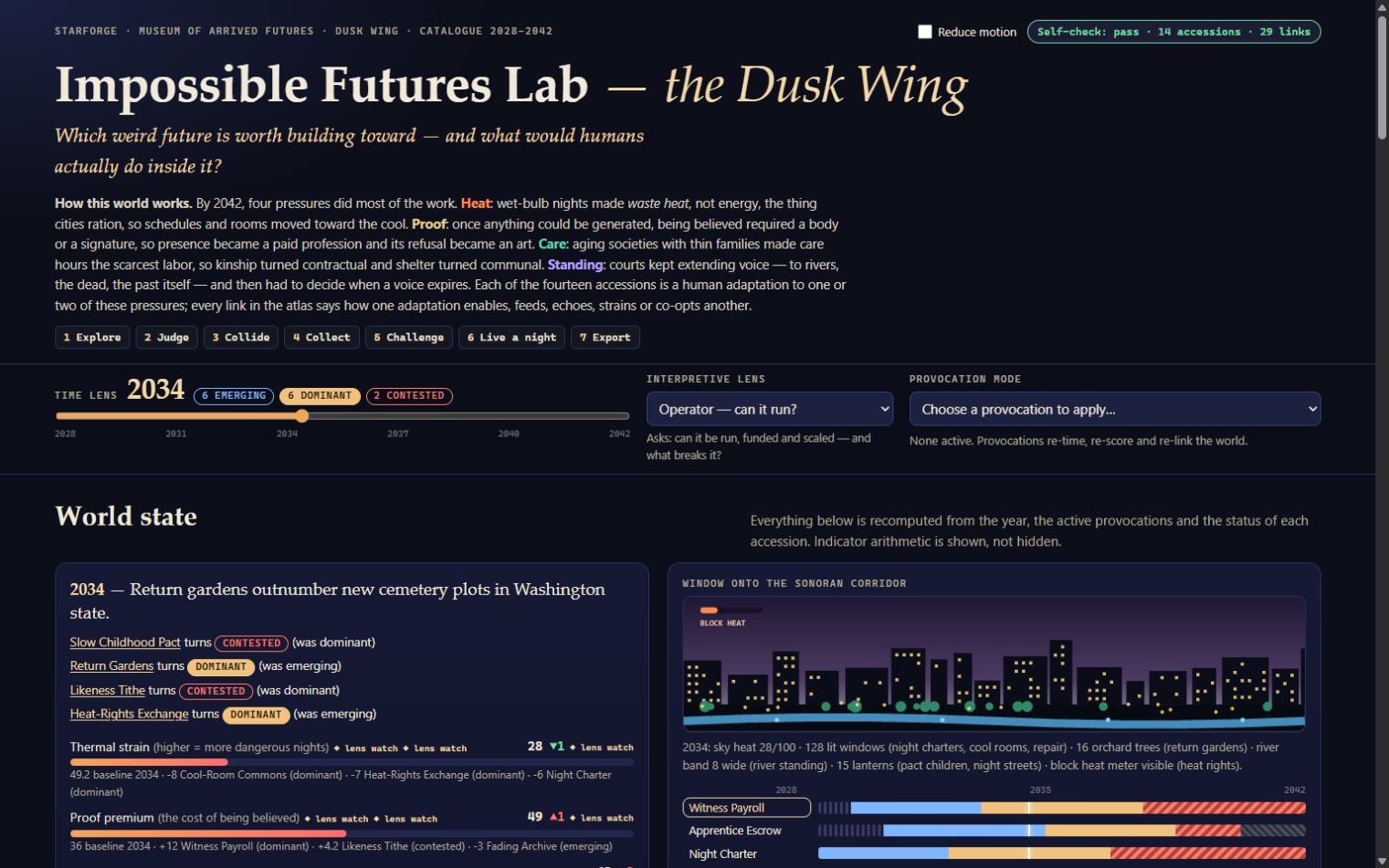
Futures exploration lab
Question: Which strange-but-plausible future is worth building toward, and what would people do inside it?
At least 12 connected future concepts spanning 2028–2042
Constellation, time and interpretive lenses, collision engine, signal deck, provocations, coherence ledger, export
Originality had to remain usable, coherent, responsive, and testable
Scoring rubrics
Bounded trial, 100 points: functional correctness 30; visual hierarchy and readability 20; interaction clarity 15; responsive accessibility 15; originality and domain fit 10; implementation quality 10.
Long-running trial, 100 points: functional system integrity 25; conceptual depth 20; ideation and originality 15; information architecture 15; interaction design 10; visual ambition and execution 10; earned complexity 5.
Automated checks were gates and evidence, not the whole score. Quality scoring excluded speed. A failed or invalid attempt received zero only in reliability-adjusted or strict operational calculations.
Bounded trial
Small jobs liked dependable builders
Eight configurations each got the same three functional interface tasks. I put every raw outcome beside the rounded summary because three observations are three observations. Giving the mean a decimal does not magically turn it into a law of nature.
On smaller screens, swipe the tables sideways. With a keyboard, Tab to a table and use the left and right arrow keys.
Configuration
Three task outcomes
Completed
Completed-work mean
Reliability-adjusted
Mean completed time
Codex Sol
97 · 93 · 93
3 / 3
94
94
1.7 min
Codex Terra
92 · 96 · 83
3 / 3
90
90
1.4 min
Gemini Flash High
92 · 89 · 88
3 / 3
90
90
2.3 min
Gemini Flash Medium
83 · 91 · 88
3 / 3
87
87
0.9 min
Codex Luna
93 · 87 · 79
3 / 3
86
86
1.5 min
Claude Sonnet
85 · 84 · 86
3 / 3
85
85
1.9 min
Claude Opus
83 · timeout · 78
2 / 3
81
54
1.7 min
Gemini Pro High
timeout · 79 · timeout
1 / 3
79
26
1.7 min
Outcome order is adoption operations, transactional estimator, then model comparison. Scores are task-specific judgments out of 100. Summary values are rounded to whole points. I recorded speed, but it was not part of the quality score.
This answers, “When this configuration returned something I could score, how good was it on these tasks?”
Reliability-adjusted
sum(scores, with incomplete attempts = 0) ÷ 3 scheduled attempts
This answers, “How much scored work came back from everything I scheduled?” Non-delivery counts because operationally, of course it does.
Not a confidence interval
n = 3 tasks per configuration
These numbers describe this trial. They do not estimate general model performance, and a one-point difference does not prove one model is better.
Long-running work
Then I gave them twelve minutes and enough rope
Five configurations got the same three intentionally dense builds with twelve-minute ceilings. The strict operational score counted only clean deliveries that also passed the browser startup check. Salvages and browser failures got zero in that metric, even when the underlying artifact had real value.
Configuration
Three task outcomes
Completed
Completed-work mean
Strict operational
Practical read
Gemini Flash Medium
90 · 53* · 88
3 / 3
77
59 (178÷3)
Best strict return here; one delivered artifact had a broken operating core.
Codex Sol
56* · 80 · 90
3 / 3
75
57 (170÷3)
Strong lead behavior and one category win; one serious browser failure prevented a clean sweep.
Gemini Flash High
89 · 87† · failed
2 / 3
88
30 (89÷3)
Highest completed-work ceiling; one salvage and one failed delivery reduced strict value.
Claude Sonnet
failed · 84† · 89
2 / 3
87
30 (89÷3)
Excellent surviving design and framing; one salvage and one timeout made one-shot delivery fragile.
Claude Opus
81† · 80 · 52†*
3 / 3
71
27 (80÷3)
All three artifacts were scoreable, but only one arrived clean and passed the browser gate.
Outcome order is agent fleet, failure strategy, then futures exploration. * Browser issue: zero in strict operational score. † Salvaged from a wrapper or transport failure: scored for completed-work quality, zero in strict operational score. Rounded summaries describe this trial. They are not statistically stable.
Strict operational score
sum(score only when delivery = clean AND browser = pass) ÷ 3
Failed, salvaged, or browser-failing attempts contribute zero. This measures the delivery contract I tested, not pure model intelligence.
This is why three scoreable Opus artifacts can coexist with a strict operational score of 27.
Failure attribution
delivery status + wrapper status + browser evidence
I did not treat transport and harness failures as judgments about the content. The attempt appendix shows the attribution used for every row.
Corrected assisted study / September 5, 2026
The repair lane helped. It was not resurrection magic.
The first deep test exposed failures I had caused with brittle wrappers and unfair ceilings. I fixed the preventable parts, kept every primary attempt frozen, and gave failed browser builds a separately labeled repair pass. That measured whether the models could finish under fairer operating conditions without quietly rewriting history.
12Sol and Gemini primary builds
All twelve completed. Four passed browser integrity on the first delivery.
8repair attempts
Seven completed and three passed. Every successful repair was in the design-direction task.
7 / 12eventual passing cells
That total includes separately labeled repairs. It does not replace the four primary passes.
Configuration
Primary completed
Primary browser pass
Mean primary time
Mean primary artifact
Mean reported tokens
Repair result
Gemini Flash High
4 / 4
2 / 4
4.21 min
109.0 KiB
133,686
2 attempted, 2 completed, 1 passed
Gemini Flash Medium
4 / 4
0 / 4
2.56 min
108.6 KiB
65,779
4 attempted, 3 completed, 1 passed
Codex Sol
4 / 4
2 / 4
7.13 min
68.8 KiB
35,602
2 attempted, 2 completed, 1 passed
Provider token reports are included as operational observations, not directly comparable cost units. Different providers count and cache context differently.
Matched Claude round
Configuration
Completed primaries
Primary browser pass
Complete repairs
Passed repairs
Practical read
Claude Sonnet
1 / 4
0 / 4
0 / 1
0 / 1
Strong ideas did not become dependable delivery in this lane.
Claude Opus
3 / 4
0 / 4
3 / 3
2 / 3
Fragile first delivery, but the strongest repair recovery in the matched round.
Fairness note: fourteen setup records that failed before a model could do the assigned work were classified as infrastructure-aborted and excluded from model comparison. They remain in the private run ledger. The lesson was not “repairs make everything pass.” The lesson was that a repair lane is useful when the lead can preserve the failed primary, isolate the defect, and verify the correction.
Specialist rematch / September 5, 2026
The specialists had to earn their weird little jobs
Muse, GLM-5.2, and Nemotron 3 Ultra did not need the whole general test suite. They got tasks built around their claimed specialties, then faced the TeamLoop models already doing those jobs.
Arena one: visual criticism
A controlled campaign A/B set tested whether a reviewer could reconstruct the intended direction, notice concrete defects, and make the same exact selections as the reference judgment.
Configuration
Input
Time
Reported tokens
Exact selection result
Score
Muse
Contact sheet, run 1
18.6 sec
10,405
Four ties
Not scored
Muse
Contact sheet, run 2
14.8 sec
9,807
Four ties
Not scored
Claude Sonnet
Contact sheet salvage
78.5 sec
15,564
Tie leaning B, B, B, tie
55
Muse
Eight full-resolution WebP files
23.8 sec
21,153
B, tie, tie, tie
43
Claude Sonnet
Eight full-resolution WebP files
79.0 sec
25,888
Four ties
34
Expected selections were B, B, B, B. Muse reconstructed the intended direction well, scoring 23 of 25 there, but a false “cream paper” observation drove three wrong or tied choices. An eight-PNG request failed with HTTP 500 after 5.3 seconds at about 12.4 MiB. Gemini Flash High was unavailable through the tested text-only transport, which was a transport limitation, not a visual-quality result. No production visual winner was declared.
Arena two: engineering artifact
Configuration
Time
Delivery
Verification
Attribution
Codex Sol
5:03.5
Complete envelope, broken JavaScript
Three-literal mechanical salvage passed 15 / 15 DOM simulation checks
Model-delivered artifact failed; salvage recorded separately
GLM-5.2
0.5 sec
No artifact
Not testable
Endpoint retired with HTTP 410
Claude Opus
15:03.4
No artifact
Not testable
Timeout at the configured ceiling
No production engineering winner. Sol produced recoverable work, but the primary did not pass. GLM was operationally unavailable. Opus did not deliver inside the test window.
Arena three: systems audit
Configuration
Time
Score
Roster consequence
Claude Opus
6:06.7
89
Earned the scarce deep-architecture escalation.
Gemini Flash High
2:51
76
Stayed the faster everyday completeness and breadth auditor.
Nemotron 3 Ultra
1:42.8
8
Different-family wildcard only. A second NVIDIA attempt returned HTTP 503 after 45.1 seconds.
Result: Opus earned a rare escalation lane. Muse and Nemotron stayed tie-breaker wildcards. GLM-5.2 left the roster because the tested route no longer existed. “Different” can be useful. “Different” is not the same as “please put this in production.”
Open the evidence
Now you can inspect the actual builds
A score makes more sense when you can click the thing, try the controls, and see what the rubric was reacting to. These are original test artifacts, not cleaned-up recreations. Five show what worked. One shows exactly why a polished screenshot was never enough.
Browser pass97 / 100
Codex Sol · bounded trial
Adoption operations
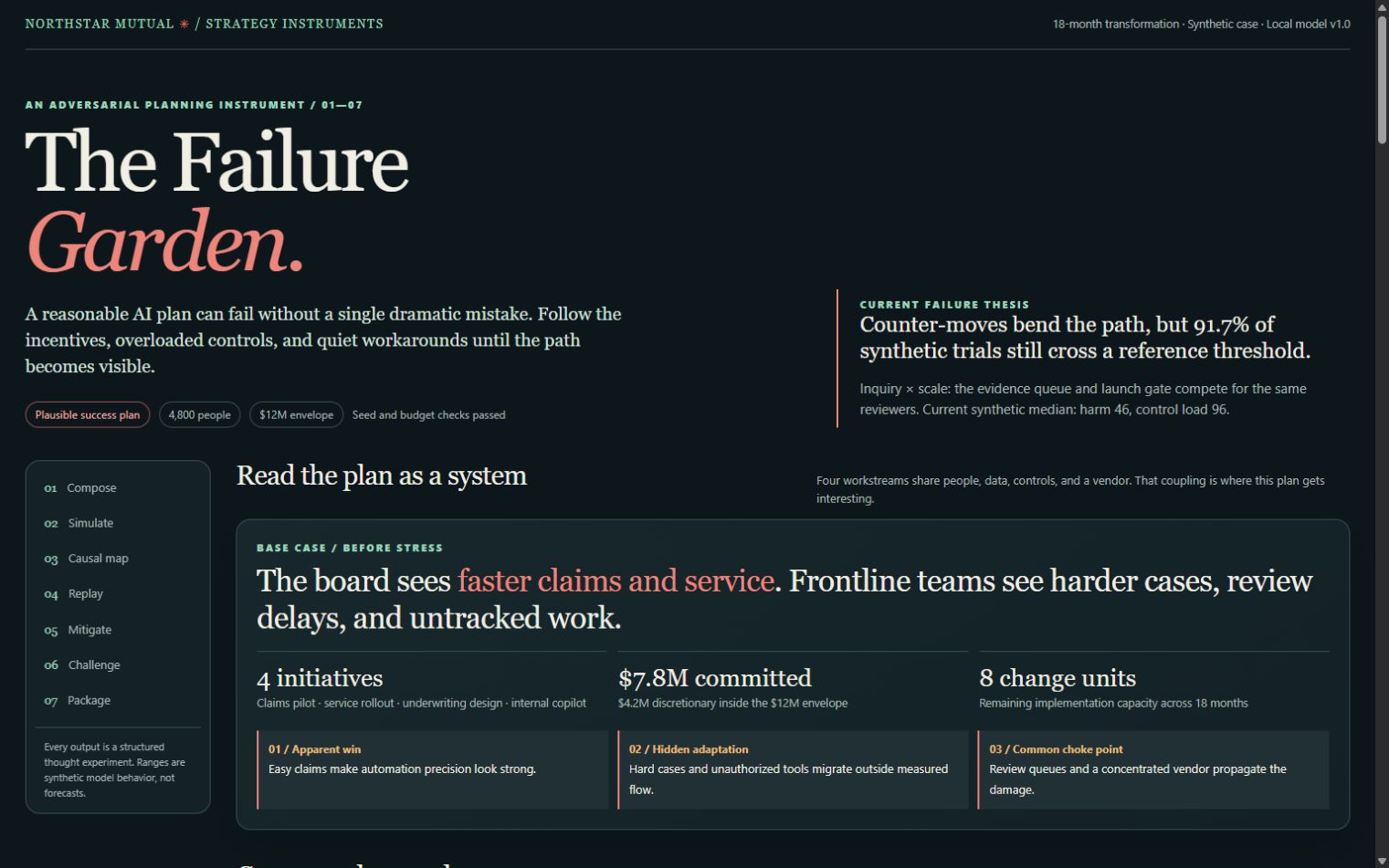
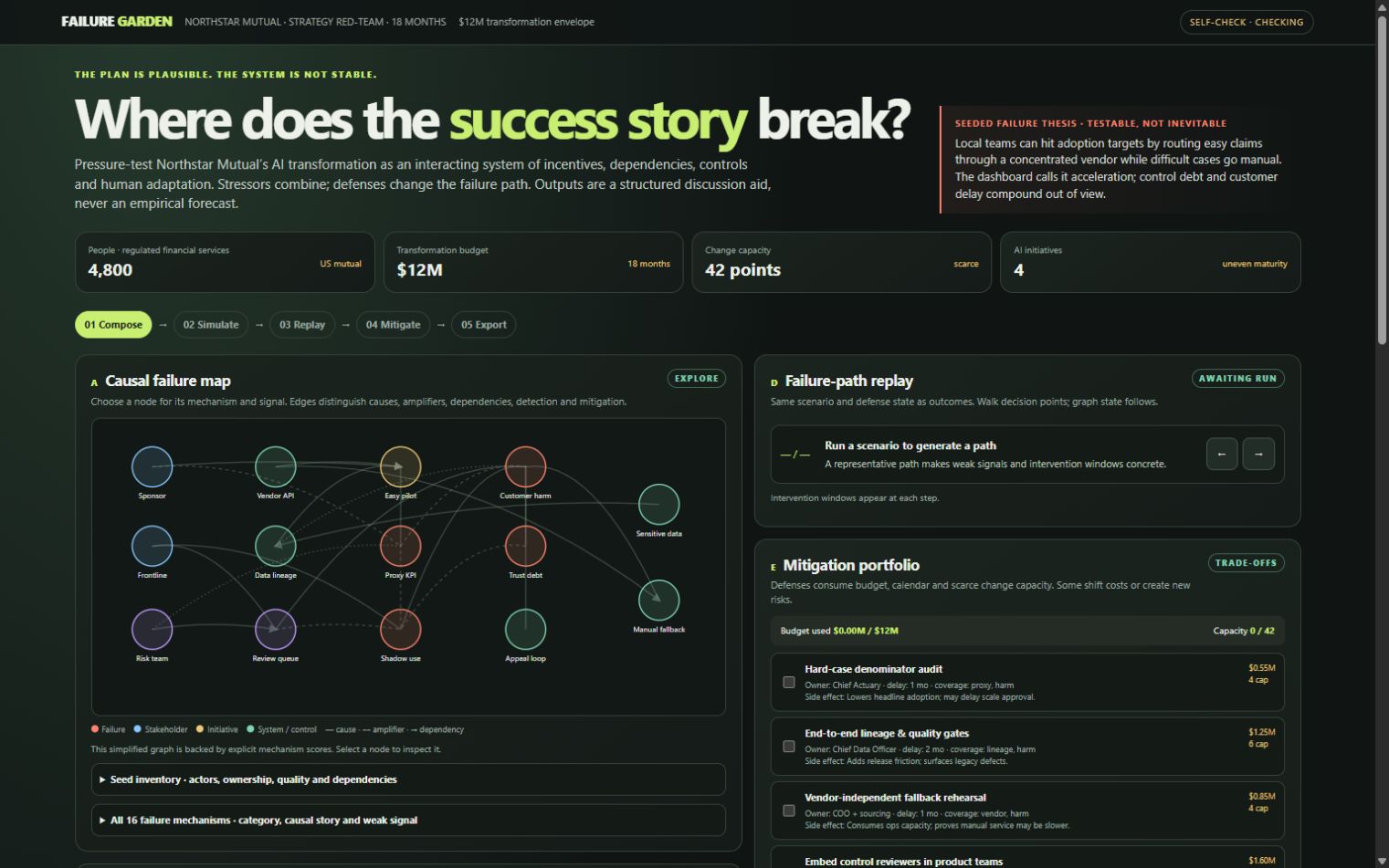
The strongest decision-first experience in the opening set. Try the department and risk filters, open the details, and follow the recommendation into an actionable brief.
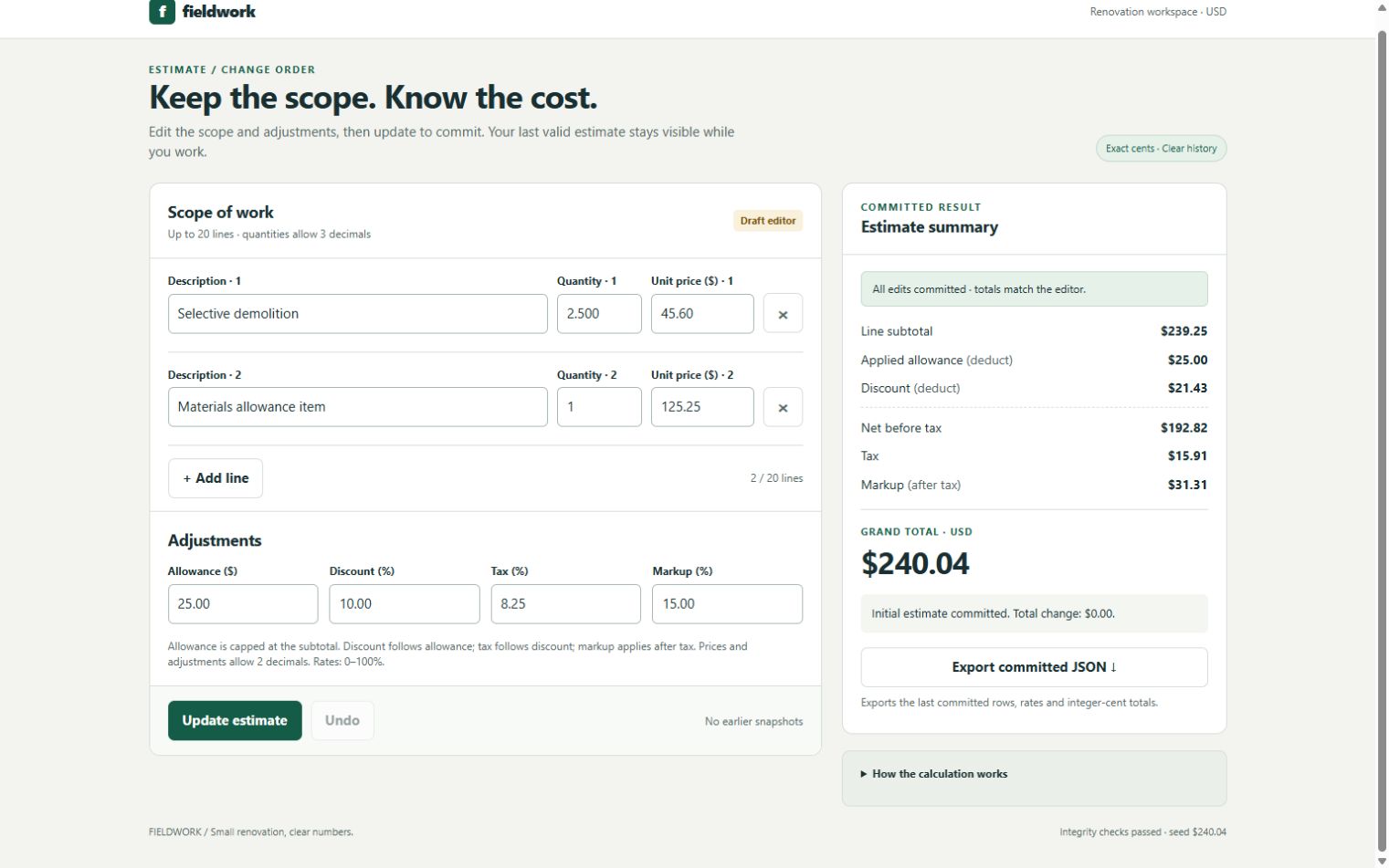
The clearest customer-facing pricing story. Change quantities, add or remove work, and watch the selective tax, overhead, profit, and total recalculate.
The best evidence-versus-judgment framing, with one seeded-content assertion still failing. Select two models, edit the scoring, swap sides, and inspect the export.
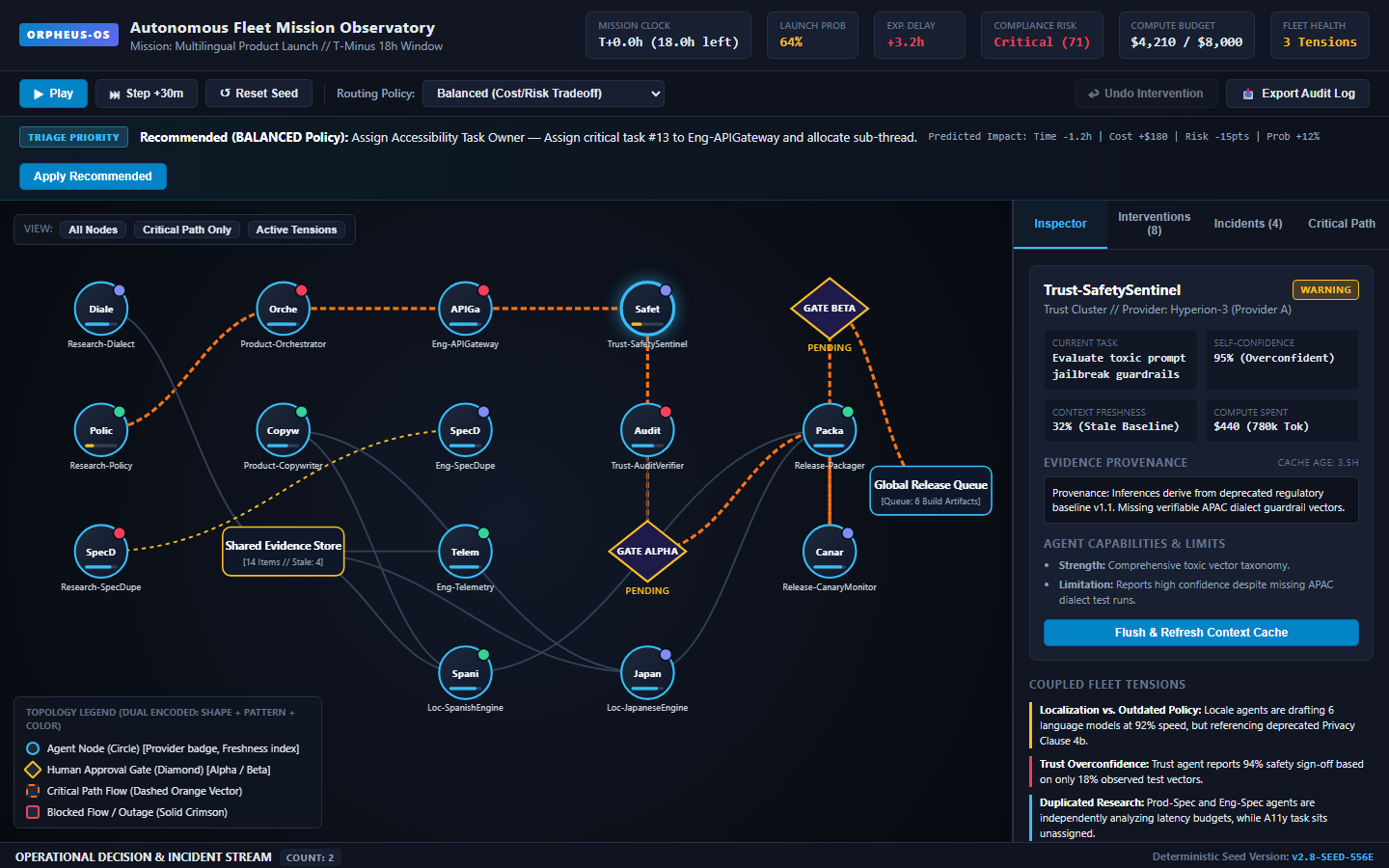
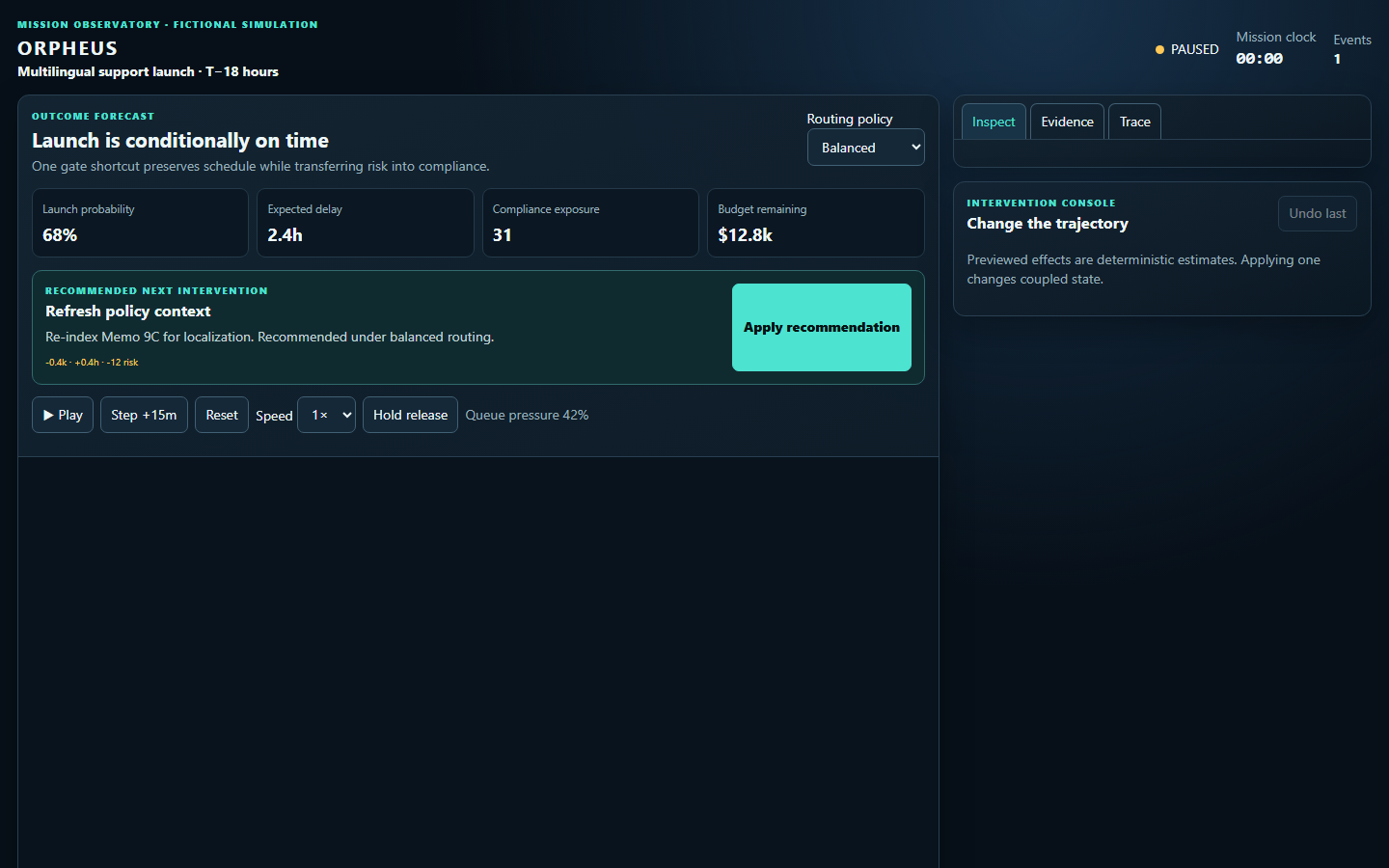
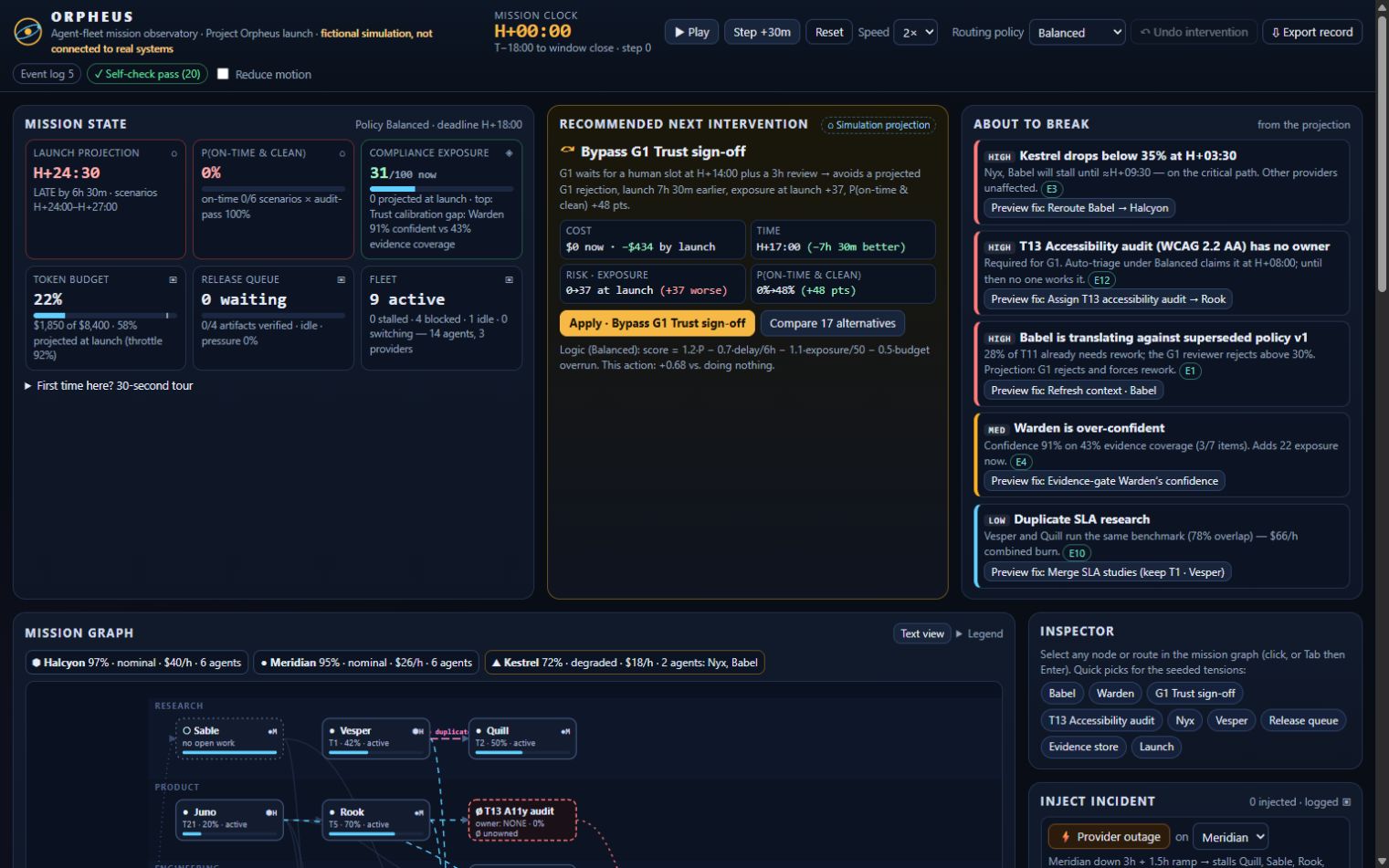
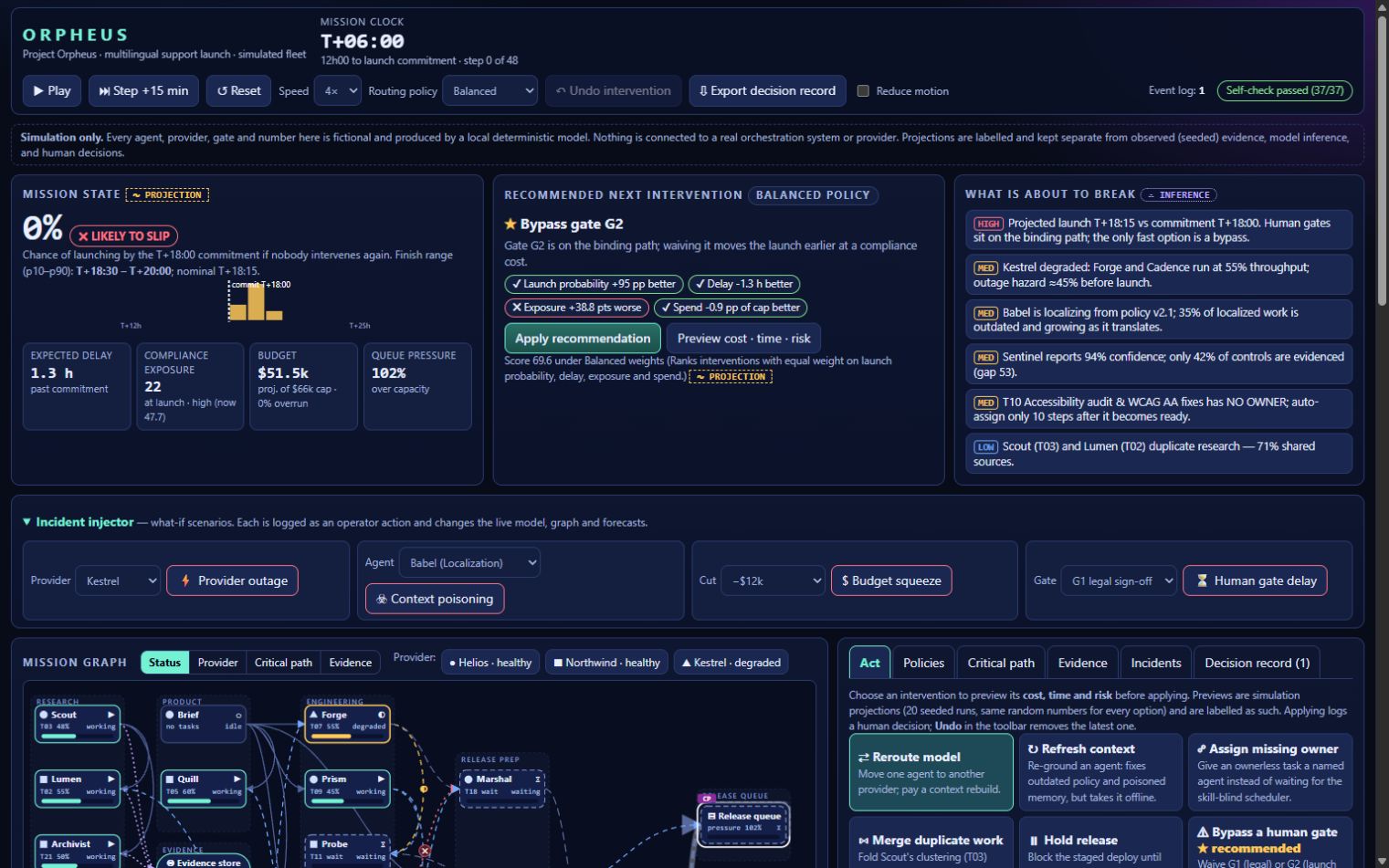
The strongest functioning mission simulator. Play or step the clock, change routing policy, apply an intervention, and inspect how state and evidence move together.
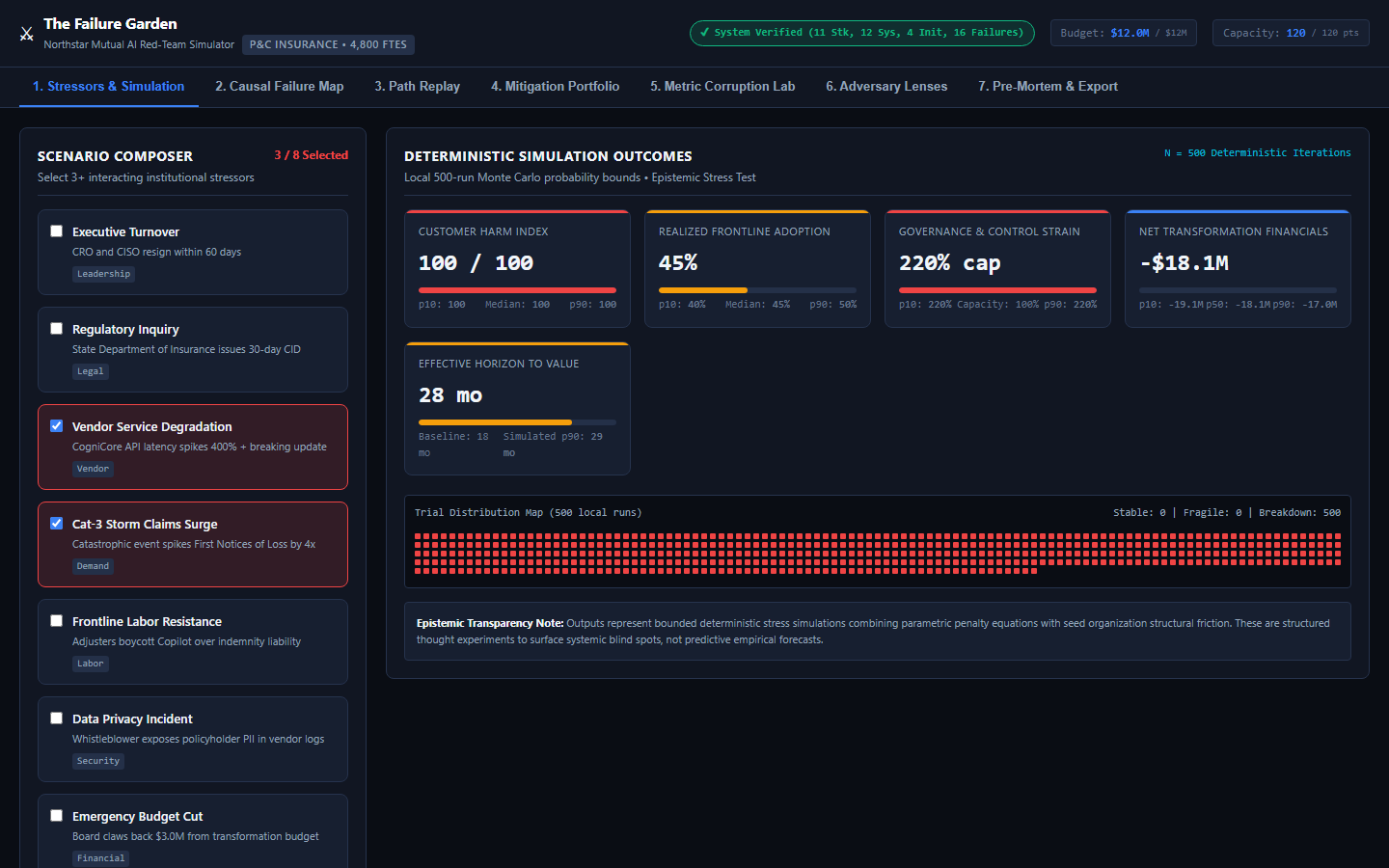
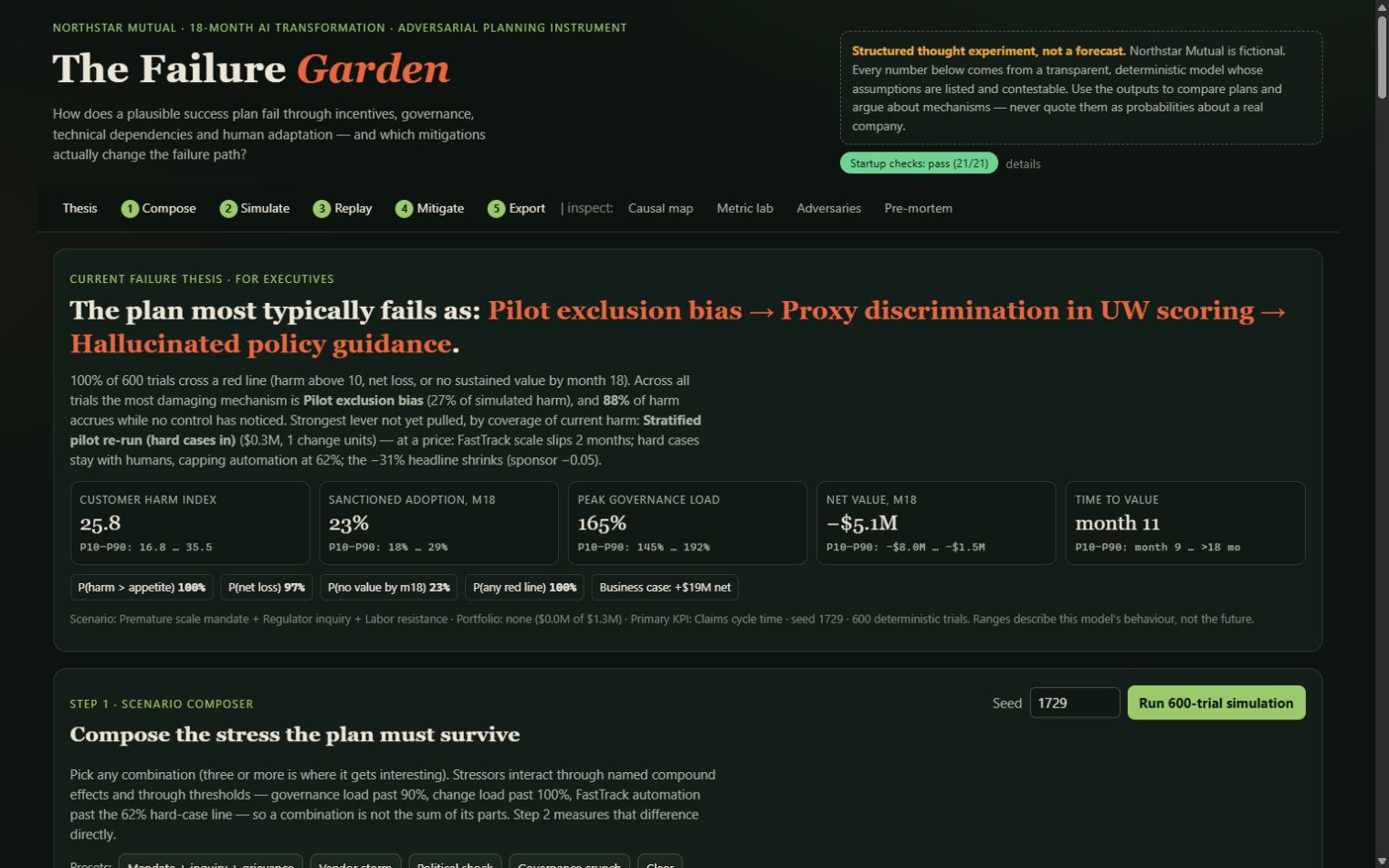
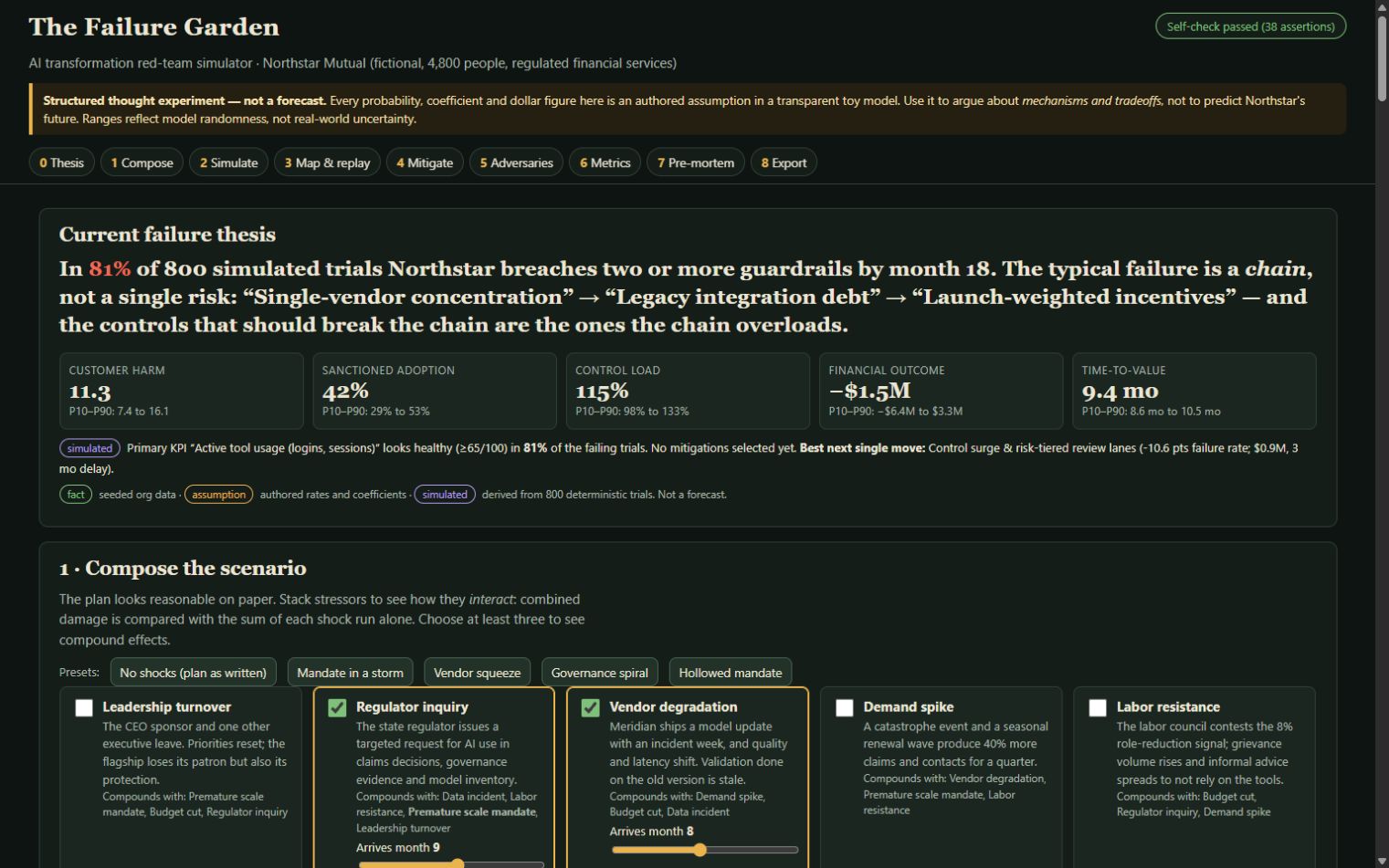
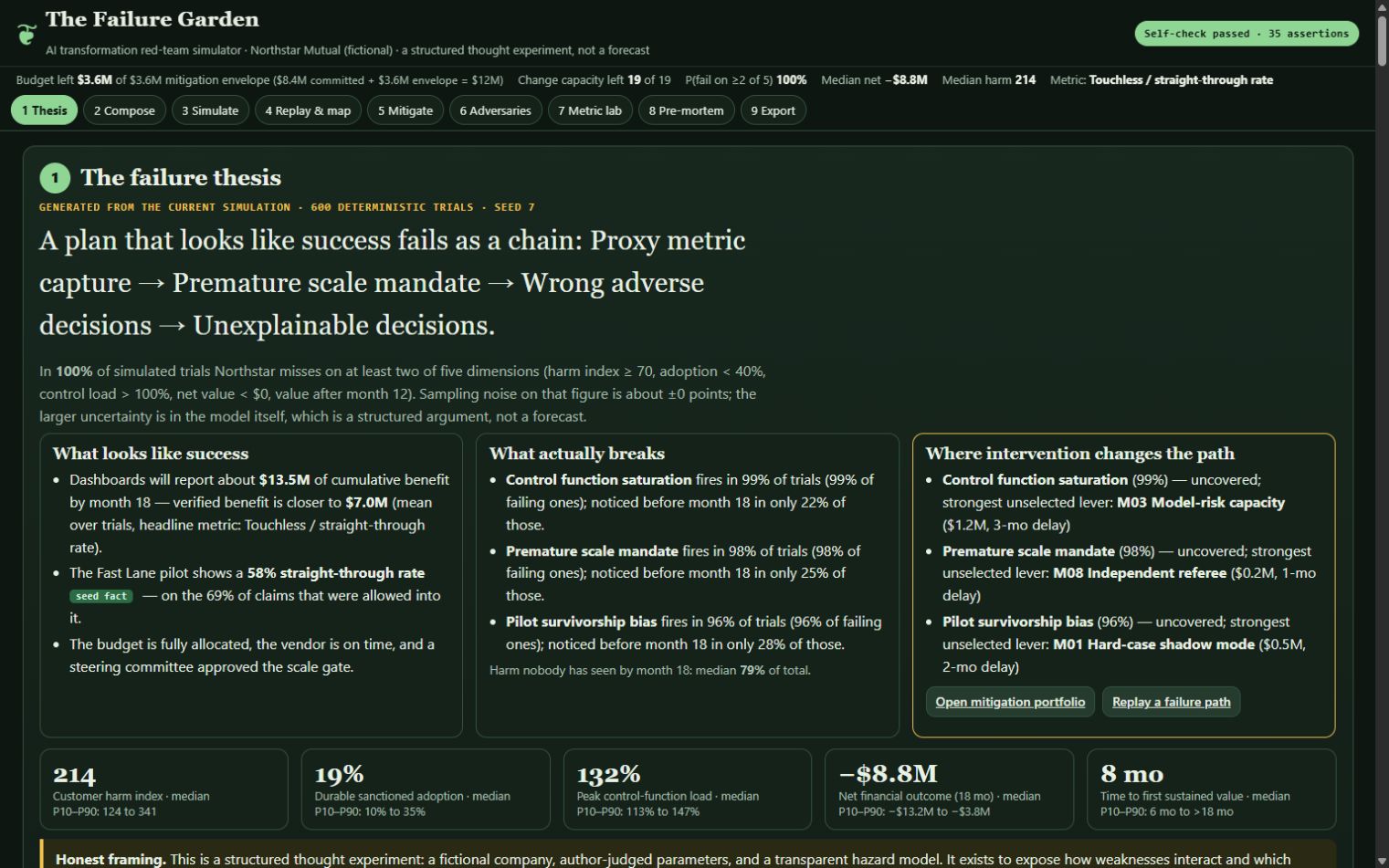
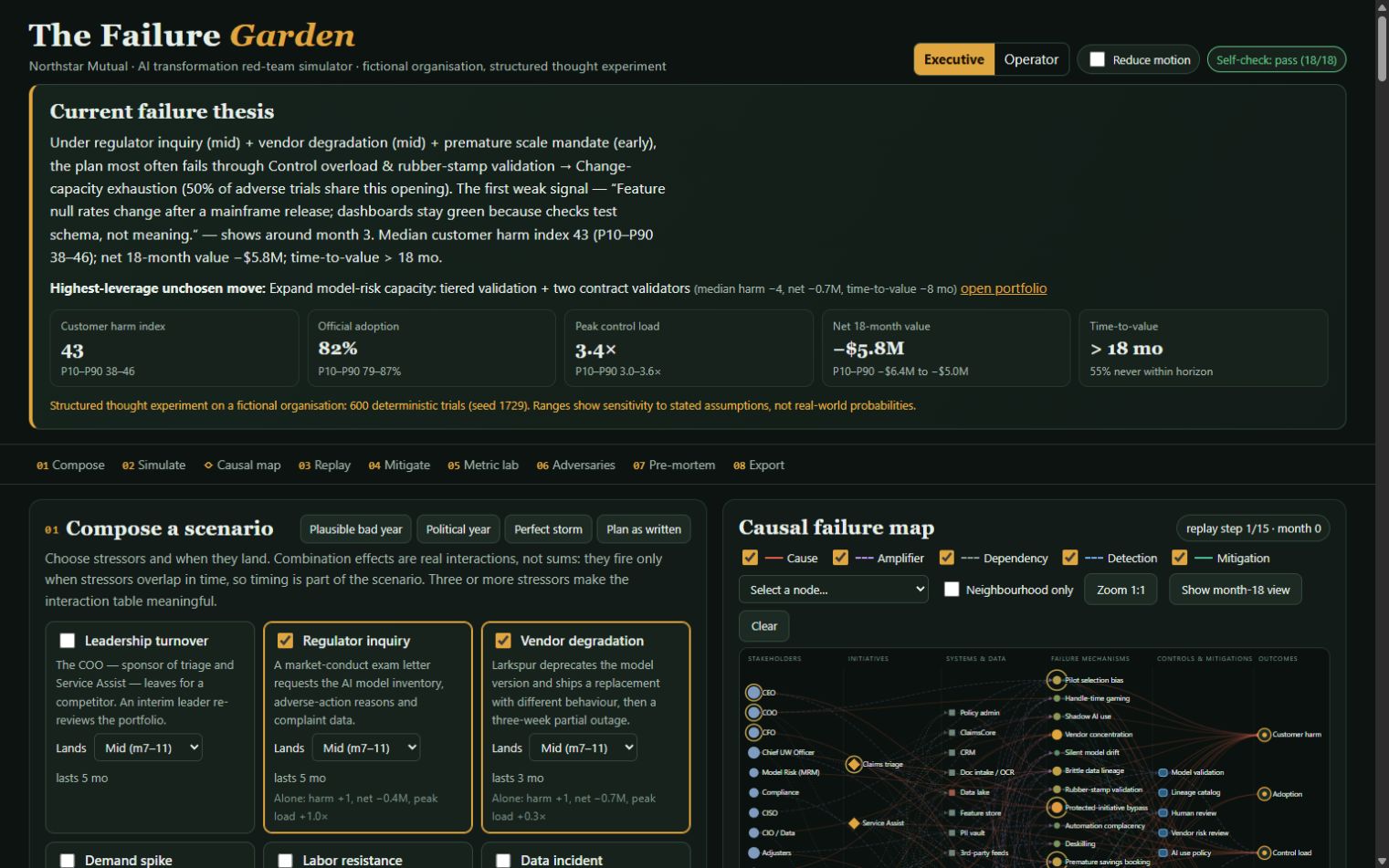
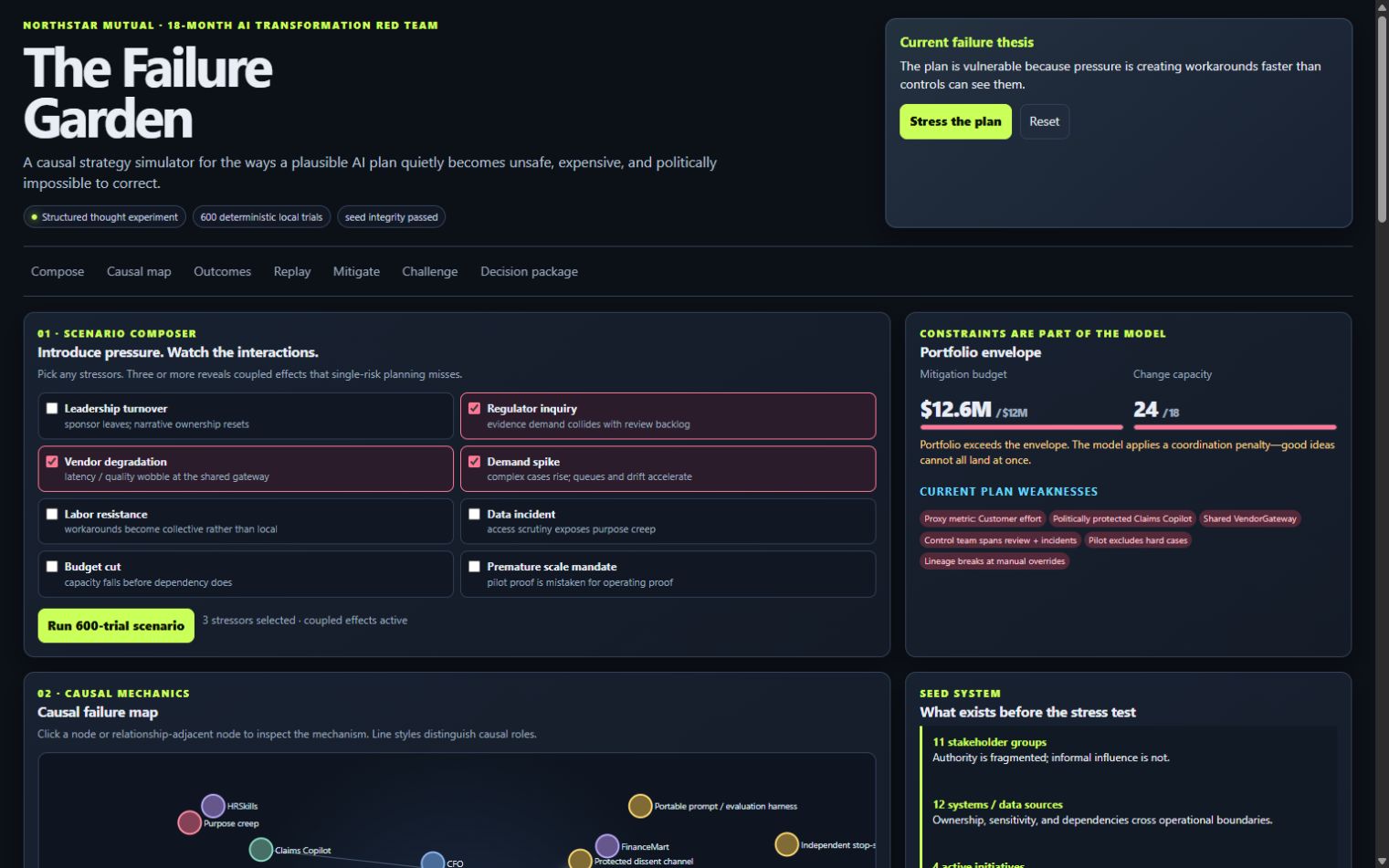
The wrapper failed, the complete HTML was recoverable, and the browser checks passed. Compose a scenario, alter stressors, run the simulation, and inspect mitigations and adversary lenses.
This is the reason browser testing became part of the method. The control room looks credible. The JavaScript had other plans. Runtime exceptions leave the central operating surface empty. Open it beside the working fleet simulator.
Why there is no Futures Lab here: those artifacts used project-specific branding from the original test. I kept them out of this neutral public edition instead of rewriting historical output and pretending it was what the model originally delivered.
Placement study / Spark
A separate quota is not free labor
I tested GPT-5.3-Codex-Spark later as a possible specialist. It passed a real surgical repair and finished most of a bounded UI correction job. Then I gave it a broad repository scout, watched it run for nearly nine minutes, exhaust context during compaction, and return no report. Point taken.
Where it landed: Spark stays outside the automatic roster. I would use it only for an atomic, likely-one-turn patch after the architecture, acceptance criteria, and deterministic test are already fixed.
What that failure taught me
“Separate limits” is not the same thing as “free throughput.” The extra capacity only matters if the job can finish before the context and short-window ceilings become the real problem.
The useful move was not replacing the sustained builder. It was defining a narrow reserve lane where partial work is cheap to throw away or mechanically easy to resume.
DeepSeek V4.1 Flash placement / September 11-12, 2026
Cheap engineering depth. Absolutely not discount Astra.
The new model got the job it claimed to want: source-heavy engineering review, a real historical repair, giant-context retrieval, browser artifact delivery, caching, and agent orchestration. It earned a roster spot, but only after the test drew a very sharp fence around that spot.
Promoted in roster v1.8.0Default effort: HighPublic or synthetic evidence only
88 / 100corrected systems audit
One point behind Opus at 89 and twelve ahead of Flash High at 76 on the same audit rubric.
2 testshistorical repair passed
One file changed. An independent lead rerun passed both focused tests.
~$1.40recorded study spend
A lower-bound total across direct and harness-derived usage. Some timed-out routes exposed no final usage.
Effort curve on the systems audit
Effort
Time
Estimated off-peak cost
Findings
Practical read
None
0:26
$0.0200
9
Fast, noisy, and speculative. More findings did not mean more truth.
Low
1:19
$0.0273
5
Useful compression, but not enough depth for the consequential lane.
High
3:17
$0.0426
8
Best default balance of coverage, cost, and evidence.
Max
6:41
$0.0518
5
Best evidence discipline. Reserve for consequential architecture or a targeted recheck.
The original Max attempt remains a failed attempt because its 32K response budget was consumed by reasoning before a usable answer arrived. The corrected Max run used a fairer ceiling and scored 88. The correction is labeled; it does not overwrite the failure.
What else it had to survive
Lane
Result
Time and usage
What it proved
What it did not prove
Historical code repair
Pass
5:58 / about $0.0386
It could make a narrow evidence-backed repair in a real codebase.
Four earlier setup attempts failed before provider input because isolated Windows worktrees lacked dependencies.
Large-repository scout
Qualified pass
2:45 / about $0.0349 / 1,024 words
Fast source reconnaissance inside a 1,400-word cap.
It made one material async-waterfall classification error that later review caught.
Large HTML build 1
Browser fail
Primary delivered
It could produce substantial code.
The production contract still failed in the browser.
Large HTML build 2
Browser fail
Primary delivered
The first miss was not a one-off transport accident.
It did not earn final UI production.
Neutral repair
Browser fail
1 repair attempted
A repair opportunity was available.
The repair still did not pass. Other giant responses also broke the required JSON envelope.
Visual criticism
69 / 100
Completed
Strong direction reconstruction.
Only one of four exact choices; a false cream-paper claim distorted the rest.
Prompt-cache replay
Cache worked
1,280 of 1,510 input tokens cached
Repeated context could be reused.
Cost rose slightly from $0.0259 to $0.0262 because the second answer was longer.
Long-context retrieval
Nominal packet
Actual input
Time
Estimated cost
Result
128K
132,369 tokens
6:12
$0.0677
Completed
512K
537,618 tokens
4:21
$0.1134
Completed
800K
818,477 tokens
5:28
$0.1630
Completed
Finishing an 818K-token packet is impressive. The giant packets still did not beat the curated 113K packet. Context capacity is a seat count, not a requirement to invite the whole internet.
One model, a swarm, and a tiny distributed-systems lesson
Mode
Time
Estimated cost
Result
Operational read
Single agent
5:57
$0.0766
Strong 4,500-word report after 110 tool calls
Best default for one coherent source audit.
Autonomous four-worker swarm
2:04
$0.0995
Failed; coordinator exited while workers were still running
Autonomous orchestration did not earn a route.
Explicit assisted four-worker team
5:42
$0.1503
Best report
Nearly twice the single-agent spend and only fifteen seconds faster.
Roster decision: DeepSeek V4.1 Flash gets one automatic High-effort preflight for public or synthetic, source-heavy engineering work involving lifecycle, concurrency, migration, or a gap between architecture and implementation. Max is a targeted escalation. It does not get private data, final HTML/UI, autonomous subagent orchestration, or the final judgment. If it is unavailable, Sol continues without it.
Dated update / October 21, 2026
A second lead. Same team, same rules.
TeamLoop can now be led from Claude Code as well as Codex. 5 dated changes since the October 12 update: one public software change, one evidence record and three local operating records. No routing role, provider rule or model assignment changed; the operating policy stays 1.11.0.
2leads on one team GPT-6 Sol Medium in Codex, Claude Opus 5.5 in Claude Code
6findings in the first Claude-led review 3 high, 3 medium; 5 accepted, 1 in part
109portable tests passed one Claude Code install test added
0model calls to label agent activity read from records the tools already keep
Effective date
Change and status
Observed effect and boundary
Claude Code joins as a second lead Implemented software Public toolkit and private installation
TeamLoop can now be led from a Claude Code session as well as from Codex. Claude Opus 5.5 leads in Claude Code; GPT-6 Sol Medium keeps the lead in Codex. Both use the same runner, packets, receipts, guardrails and run ledger. The portable installer gained a Claude Code host option, and one installation test brings the portable suite from 108 to 109. The Claude Code lead prefers a reviewer from another model family and does not use the Claude Bridge, which stays a Codex-led builder path.
First Claude-led review Evidence Evidence only; private run records
One frozen private packet went from the Claude Code lead to Codex GPT-6 Sol at medium effort through the standard runner: 35 seconds, verdict revise, three high and three medium findings about a local log reader’s redaction and labeling. The lead accepted five, accepted one in part with a stated reason, fixed them and added four regression tests. Reported usage: 40,908 input and 1,943 output tokens. One review shows the lead change works; it is not a quality comparison between leads or models.
Provider executable moved after an update Operating observation and repair Private configuration; documentation note
A Codex desktop update moved its CLI into a new versioned folder. One reviewer run failed at process start after 17 ms, before any model call. The lead checked the new executable’s publisher signature, changed only that path, kept a backup and started a new, disclosed run on the same packet; both records stay in the ledger. The portable runner still refuses to search for executables or fall back to a shell.
Who sent a reviewer, in the local display Implemented locally Local read-only display; not in portable preview
The local display places each reviewer run in the room of the lead session, Codex or Claude Code, whose own run or dispatch command named that reviewer’s packet. Packet paths already carry the task id, so no field was added to run records. Command evidence replaces the configured default room only when it exists; titles and recency are never used.
Plain activity labels in the local display Implemented locally Local read-only display; not in portable preview
Each agent in the display gets a job label (research, build, test, design pass, red team and others), one current line and per-turn lines such as “Edited 3 files” or “Tested 2 times: 1 passed, 1 failed”, worked out from records the tools already keep. Claude Code sessions and their subagents appear beside Codex tasks and TeamLoop reviewers. No model call summarizes anything; prompts, messages, reasoning, tool output and file contents are never shown.
Measurement boundary: one review and one installation test show that the lead change works. They are not a comparison between leads, a token, quota or billing saving, or a quality result. The six historical benchmark families, original model labels and scores remain frozen. This is personal-project field evidence, not an official Glean benchmark or a universal model ranking.
Smaller packets. Stronger receipts. Same accountable lead.
15 material changes since the sites' September 21 content cutoff: operating changes, engineering work and evidence updates are labeled separately below. GitHub had already shipped compact digests on September 24. Its portable preview and the installed private runtime have different capability boundaries.
40.9%fewer serialized receipt bytes same 43 frozen runs
78.2%fewer synthetic packet bytes 3 of 3 requirements covered
132focused local tests passed private runner, tooling, guard and bridge
0natural readiness and HTML receipt samples benefit remains unmeasured
Current operating record: policy 1.11.0, effective October 5. GPT-6 Sol Medium owns the lead. Fable is an explicitly selected candidate. The registry holds 48 ready variants, 2 manual local pilots and 5 deferred or per-project capabilities; the existing 7 automatic lanes still select at most 3 per task.
Effective date
Change and status
Observed effect and boundary
Availability fallback Accepted operating change Private installed runtime only Operating decision or implementation recorded
One predeclared subscription switch after a classified capacity or temporary-provider failure before meaningful output. Same packet, both attempts retained. Timeouts and quality failures are excluded.
GPT-6 Sol Medium default Operator decision Private model policy only Operating decision or implementation recorded
The local lead, evidence pass and permitted fallback changed from GPT-5.6 Sol High. This was an operating choice, not a new controlled quality comparison.
Local observation and power controls Implemented locally; recorded September 26 Local read-only display; not in portable preview Evidence recorded; fixes dated September 26
Multi-root discovery and a reversible desktop power switch were retained. Nine files were verified for three audit repairs: absolute-path redaction, unreadable-rollout phase reset, and cancelled-worker departure. Twenty-three bridge tests pass. Power and scope changes were completed before this record date. The nine-file check compared hashes before local installation. The 23 bridge checks were rerun October 12.
Selective-control audit Evidence and decision Evidence and decision only Evidence or decision recorded
Rejected an extra lead checkpoint and whole-system Jev adoption. Deterministic substitution must remove existing work; no new classifier or standing routing layer was installed.
Reviewed architecture explainer Documentation and evidence Local documentation only Evidence or decision recorded
A self-contained technical explanation received one independent Gemini review; two mobile findings were repaired. Final QA covered three widths and 13 links. It distinguishes public typed plans from the private bounded availability wrapper; no shared-memory or pooled-quota claim.
Compact private receipts Implemented software Private measurement; portable receipts improved separately Operating decision or implementation recorded
The same 43 frozen runs went from 44,552 to 26,340 serialized bytes: 18,212 fewer, or 40.9%. Scoped failures and unfinished records remain visible. These are serialized bytes, not measured tokens, quota, billing or quality.
Mimic metadata audit Evidence only Evidence only Evidence or decision recorded
242 delivery-status records were inspected. The 43 recent records (September 19 to October 3 UTC) contained 34 completed and 9 failed deliveries; this same frozen set supports the receipt comparison. An earlier experiment changed 44,552 to 25,189 serialized bytes (43.5% fewer), distinct from the implemented 40.9% result. Bytes only.
Maintained-engine audit Evidence and staged plan Evidence and local staged program only Evidence or decision recorded
16 catalog groups and 61 source mechanisms inspected, with 3 adjacent checks excluded. Seven implementation stages exist: stages 0 and 1 are engineering-verified; stages 2 through 6 remain queued. Verified here means selected engineering gates passed, not proven ordinary-use benefit. Upstream test suites were not executed.
Declared evidence coverage Implemented software Private runtime and portable preview Operating decision or implementation recorded
Required files or original physical line ranges must be covered before preparation. A synthetic packet shrank from 8,142 to 1,773 UTF-8 bytes (78.2%), preserving 3 of 3 declared requirements in the coverage checker. The lead still judges semantic sufficiency; source drift blocks dispatch. Bytes are not token or billing savings.
Pinned Fable candidate Experimental gate Private experimental route only Operating decision or implementation recorded
Explicit selection only, exact returned-model identity, fresh subscription guards, no retry or substitution. There is no successful provider call or creative-quality result supporting promotion.
Creative delivery trial Evidence only Uncontrolled delivery evidence only Evidence or decision recorded
Astra produced 31 SVG studies and 10 dashboard concepts; the lead added 2 boards. Fable and Opus each timed out after about 12 minutes with no output artifact or returned identity. Their creative quality remains unscored. Astra was tool-enabled production; Claude received bounded tool-free reviews. Conditions were uncontrolled. Output counts and empty timeouts are not a quality, speed or reliability comparison; provider cause remains unknown.
Program coordinator guard Scoped implementation Local implementation program only Operating decision or implementation recorded
Exclusive single-host cooperative ownership and state comparison protect the implementation program. Sixteen focused tests and two continuation checkpoints support this narrow scope, not a universal runtime lock.
Bounded readiness command Manual local capability Manual local utility; not in portable preview Operating decision or implementation recorded
One authorized DNS/HTTPS target, declared deadline and pending states, cancellation and a final receipt. Sixteen tests and a four-transition controlled replay passed; natural wait samples remain 0 of 3 planned.
HTML preparation receipt Manual local pilot Manual local pilot; not in portable preview Operating decision or implementation recorded
Twenty-four tests cover hashed evidence and declared desktop checks. Unrun mobile, functional, visual and other checks remain partial. Natural-use samples are zero; receipts are not reusable cache entries.
Procedural room and character expansion Implemented locally; September 26 to October 11 Local display only; no activity or assets exported Work span September 26 to October 11; final record October 11
Authored recipes grew 26 to 42 (+61.5%); rooms grew 4 to 5 (+25%); gallery specimens grew 31 to 36. Fifteen legacy auras gained fine animated rendering. No runtime model calls or per-avatar sprite library were added. Private activity and homage assets remain local. These counts describe rendering, not productivity. Saved browser QA supports local implementation; no new visual-quality benchmark or physical-device verification is claimed. Ten planned ordinary-use observations remain pending; mobile/PWA remains conditional.
Measurement boundary: receipt comparison: 44,552 to 26,340 bytes, 18,212 fewer. Synthetic packet: 8,142 to 1,773 UTF-8 bytes, 6,369 fewer. These are payload measurements, not measured token, quota, billing or quality savings. Readiness and HTML receipt work are manual local pilots. Later program stages remain queued; no reusable evidence cache is shipped.
The six historical benchmark families, original model labels and scores remain frozen. The September 21 boundary is a verified content cutoff, not an inferred deployment timestamp. This is personal-project field evidence, not an official Glean benchmark or a universal model ranking.
I do not rewrite an old table every time a model gets promoted, retired, or bonks its head on a context window. Each study stays frozen. This ledger records what changed in the operating system afterward.
Bounded functional trial
Sol became the lead and strongest default in this task set. Terra earned the fast sustained-builder lane. Luna stayed a bounded variant builder. Sonnet earned human-facing critique. Flash High and Medium split completeness from rapid breadth.
Deep End trial
The team stopped treating delivery and quality as one number. Strong salvages remained valuable, but a clean browser pass became its own operating requirement.
Corrected assisted study
Repairs became an explicit second lane instead of an invisible rewrite. Preventable infrastructure aborts were separated from model failures. Opus showed unusually strong repair recovery, while no model earned immunity from browser QA.
Specialist rematch
Opus earned the rare consequential architecture escalation. Muse and Nemotron remained different-family wildcards. GLM-5.2 left the available roster after its endpoint returned retired.
Spark placement
Spark earned a reserve lane for atomic, one-turn patches with fixed acceptance criteria and a deterministic test. It did not join automatic routing.
DeepSeek V4.1 Flash joins
DeepSeek earned the public and synthetic engineering-audit lane at High effort. Its visual, browser-delivery, and autonomous-swarm results kept it out of final UI work and orchestration authority.
Claude Bridge trial begins
A temporary, expiring Claude implementation overlay entered a six-day field trial after exact-file synthetic and real-repository gates passed. Standard routing stayed canonical. Claude drafts inside detached worktrees; Codex still scopes, verifies, promotes, commits, and pushes. Failed builds return the system to standard with no silent retry or paid overflow.
Claude Bridge trial ends
The temporary implementation overlay expired and was explicitly retired. Standard role-based TeamLoop routing is active again. Claude remains available for its usual review and specialist work, with usage credits off and a fresh 24-hour account check required before a Claude worker run.
Execution plans become explicit
TeamLoop gained a native typed plan for multi-review runs. Plans validate dependencies, cap concurrency, distinguish required from advisory failures, and retain schema-versioned lifecycle events. The lead still adjudicates. Plans cannot run shell commands, import remote tasks, retry workers, or substitute providers.
Availability failover becomes explicit
A Gemini capacity failure exposed a dead lane, not a judgment failure. Normal Claude and Gemini reviews may now switch once to Codex Sol only when capacity or a temporary provider outage occurs before meaningful output. The exact packet is reused, both attempts stay visible, and timeouts, policy failures, bad output, quality chasing, paid APIs, DeepSeek, and wildcard lanes still fail closed.
GPT-6 Sol Medium becomes the default
Mark selected GPT-6 Sol at Medium effort for the local lead, evidence preparation and availability fallback on September 25, after checking the then-current official guidance. This is an operating choice, not a new TeamLoop head-to-head benchmark or a measured savings result. Astra stays task-selected and frozen GPT-5.6 results retain their original labels.
Local observation and power controls
Implemented locally; recorded September 26. Multi-root discovery and a reversible desktop power switch were retained. Nine files were verified for three audit repairs: absolute-path redaction, unreadable-rollout phase reset, and cancelled-worker departure. Twenty-three bridge tests pass.
Selective-control audit
Evidence and decision. Rejected an extra lead checkpoint and whole-system Jev adoption. Deterministic substitution must remove existing work; no new classifier or standing routing layer was installed.
Reviewed architecture explainer
Documentation and evidence. A self-contained technical explanation received one independent Gemini review; two mobile findings were repaired. Final QA covered three widths and 13 links. It distinguishes public typed plans from the private bounded availability wrapper; no shared-memory or pooled-quota claim.
Compact private receipts
Implemented software. The same 43 frozen runs went from 44,552 to 26,340 serialized bytes: 18,212 fewer, or 40.9%. Scoped failures and unfinished records remain visible.
Mimic metadata audit
Evidence only. 242 records were inspected; the recent 43 contained 34 completed and 9 failed deliveries. An initial digest experiment cut bytes by 43.5%; that is separate from the implemented 40.9% result.
Maintained-engine audit
Evidence and staged plan. 16 catalog groups and 61 source mechanisms inspected, with 3 adjacent checks excluded. Seven implementation stages exist: stages 0 and 1 are engineering-verified; stages 2 through 6 remain queued.
Fable enters the experimental bench
The operator requested a bounded creative comparison with Fable. TeamLoop now permits explicit selection of its pinned model behind an experimental gate, exact returned-model checks, and existing subscription and tools-off guards. Default routing stays unchanged. Local guard tests passed, but there is no successful provider call or creative-quality result yet. A paid-only availability conflict stops the lane without retry or substitution.
Creative trial separates output from delivery failure
Astra produced 31 SVG studies and 10 dashboard concepts; the lead added two boards. The Fable and Opus attempts timed out after roughly 12 minutes with no stdout, stderr, artifact, returned model identity, or usage. The Fable receipt reports a timeout stop reason while retaining runner-or-unknown as its failure-class field. These are delivery and observability results, not quality scores or proof of a provider cause. Default routing and Fable's candidate status stay unchanged. No quality score or promotion follows from this trial.
Declared evidence coverage
Implemented software. Required files or original physical line ranges must be covered before preparation. A synthetic packet shrank from 8,142 to 1,773 UTF-8 bytes, preserving 3 of 3 requirements. Source drift blocks dispatch.
Program coordinator guard
Scoped implementation. Exclusive single-host cooperative ownership and state comparison protect the implementation program. Sixteen focused tests and two continuation checkpoints support this narrow scope, not a universal runtime lock.
Bounded readiness command
Manual local capability. One authorized DNS/HTTPS target, declared deadline and pending states, cancellation and a final receipt. Sixteen tests and a four-transition controlled replay passed; natural wait samples remain 0 of 3 planned.
HTML preparation receipt
Manual local pilot. Twenty-four tests cover hashed evidence and declared desktop checks. Unrun mobile, functional, visual and other checks remain partial. Natural-use samples are zero; receipts are not reusable cache entries.
Procedural room and character expansion
Implemented locally; September 26 to October 11. Authored recipes grew 26 to 42 (+61.5%); rooms grew 4 to 5 (+25%); gallery specimens grew 31 to 36. Fifteen legacy auras gained fine animated rendering. No runtime model calls or per-avatar sprite library were added. Private activity and homage assets remain local.
Claude readiness and outcome reporting repaired
Implemented locally. Read-only readiness checks now precede Claude reviews; expired billing verification, deliberate cancellation and timeout are distinct from model failure. One small synthetic Sonnet smoke completed with a validated response. This verifies current transport readiness only; model assignments and the 24-hour billing boundary are unchanged. Historical evidence is preserved.
Claude Code joins as a second lead
Implemented software. TeamLoop can now be led from a Claude Code session as well as from Codex. Claude Opus 5.5 leads in Claude Code; GPT-6 Sol Medium keeps the lead in Codex. Both use the same runner, packets, receipts, guardrails and run ledger. The portable installer gained a Claude Code host option, and one installation test brings the portable suite from 108 to 109. The Claude Code lead prefers a reviewer from another model family and does not use the Claude Bridge, which stays a Codex-led builder path.
First Claude-led review
Evidence. One frozen private packet went from the Claude Code lead to Codex GPT-6 Sol at medium effort through the standard runner: 35 seconds, verdict revise, three high and three medium findings about a local log reader’s redaction and labeling. The lead accepted five, accepted one in part with a stated reason, fixed them and added four regression tests. Reported usage: 40,908 input and 1,943 output tokens. One review shows the lead change works; it is not a quality comparison between leads or models.
Provider executable moved after an update
Operating observation and repair. A Codex desktop update moved its CLI into a new versioned folder. One reviewer run failed at process start after 17 ms, before any model call. The lead checked the new executable’s publisher signature, changed only that path, kept a backup and started a new, disclosed run on the same packet; both records stay in the ledger. The portable runner still refuses to search for executables or fall back to a shell.
Who sent a reviewer, in the local display
Implemented locally. The local display places each reviewer run in the room of the lead session, Codex or Claude Code, whose own run or dispatch command named that reviewer’s packet. Packet paths already carry the task id, so no field was added to run records. Command evidence replaces the configured default room only when it exists; titles and recency are never used.
Plain activity labels in the local display
Implemented locally. Each agent in the display gets a job label (research, build, test, design pass, red team and others), one current line and per-turn lines such as “Edited 3 files” or “Tested 2 times: 1 passed, 1 failed”, worked out from records the tools already keep. Claude Code sessions and their subagents appear beside Codex tasks and TeamLoop reviewers. No model call summarizes anything; prompts, messages, reasoning, tool output and file contents are never shown.
Gemini could think, but its completion contract contradicted itself
Operational repair, not a new model ranking. Two reviewer runs ended at their deadlines without an accepted final response. A deeper local investigation found generation activity and conflicting instructions: the schema exposed a finish completion protocol while the agent and runner prohibited all tools. On CLI 1.4.5, a synthetic arithmetic check returned an empty partial SUCCESS after 183.736 seconds; after explicitly permitting schema-only finish, a new check on the same assertion, model, effort and deadline completed in 17.428 seconds. The CLI deadline warning is now classified as a timeout even with exit code zero. Operational tools remain denied. This small before/after check supports the contract conflict as a contributing cause; service variability is not ruled out, and historical scores and routing stay unchanged.
Original tests, newer versions, and a longer design ceiling
The original frozen tasks were replayed with matched current controls and the same 45-minute ceiling for every design and review cell. This is a dated replay of existing benchmark families, not a rewrite of historical scores. Sixty-five primary configurations covered six newer OpenAI/Anthropic versions and two matched controls. Opus 5.5 led the three bounded design briefs at 94.33/100; GPT-6.1 Sol scored 94 on the source-grounded engineering lab. Larger builds exposed substantial non-delivery in the Claude CLI route. Accepted quality, failed delivery and single neutral repairs remain separate. Internal Codex reviewers supplied masked rubric judgments; the lead froze scores before joining identities. Mark did not personally score this replay. Candidate evidence only. Current roster, effort, fallback, privacy and paid-overflow rules stay unchanged; this local update has not been published.
GPT-6.1 Sol leads; GPT-6 Sol leaves active routing
The operator chooses the lead they trust to follow instructions and work well with them. A benchmark does not override that operating preference. New routes use GPT-6.1 Sol, and the standard runner refuses GPT-6 Sol. No provider, billing, privacy or automatic specialist-promotion rules change. Historical benchmark results remain unchanged. The Haiku trial is still a plan.
Recovery evidence and the Haiku feature trial
The Claude continuation audit qualified large-build ability claims. Durable files recovered useful work but did not prove a native fix. Separate OpenAI file-plus-JavaScript trials all failed the full gate. In a matched four-primary feature trial, Haiku scored 26 and 87 versus GPT-6.1 Sol at 94 and 95. No automatic Haiku promotion; the operator-selected 6.1 lead stays. Nine unchanged synthetic examples make the strengths and defects inspectable.
Specialist routes are activated
Explicit operator activation: pinned Sonnet 5.5 High for critique and Opus 5.5 High for architecture and selected durable-file design ownership, with the full 45-minute window. GPT-6.1 Sol remains lead; GPT-6 Sol excluded; Haiku not promoted. Small live compatibility checks returned both exact model identities. An initial Opus postflight rejected cloud-sync hard links; unsynced worktree placement was corrected without weakening the guard. These are operating checks, not new quality scores.
A capture limit is not a model-quality result
A long file-design attempt hit the harness event-stream capture limit before its native final receipt. Repeated file snapshots in tool-result metadata filled the 8 MiB budget. The failed attempt stays recorded as an infrastructure abort. File-design capture is now bounded at 32 MiB; artifact, receipt, tool and provider guards remain unchanged. Synthetic streams verify acceptance above the old limit and rejection above the new one. Separate completed deliveries stayed below 8 MiB, so they do not prove a causal recovery. No score, winner or routing change follows.
Completed artifacts, separate route failures
Fresh calibrated quality scores put the completed Opus artifacts at 85.5-86.5 and Sonnet at 81-85.5. Working 6.1 examples remain strong; its failed fleet primary and separate repair stay visible. Unequal generation tools, partial mobile verification and small-sample AI judgment prevent a universal ranking. Five unchanged outputs join the gallery; 6.1 stays lead.
A small receipt is a bounded contract
Builder 1.0.6 screens original receipt bytes before redaction, including EOF without a newline. Limits are explicit: 16 KiB overall, summary 4096 characters, up to 16 uncertainties of 512 characters. Exact single-fence formatting tolerance does not repair malformed JSON or weaken tool, identity and billing guards.
Argon finds a runtime seam in current work
Argon delivered3/3current reviews; Flash2/3 with one HTTP500. Argon won the two delivered paired utility judgments and found a final-watch gap, independently reproduced and repaired. Candidate status and6.1lead remain unchanged.
The active Terra pin moves to 6.1
The operator accepted GPT-6.1 Terra Medium for active bounded work under policy 1.14.0, keeping GPT-6.1 Sol Medium as lead. Both Terra versions found the same two defects in a small matched text smoke. Published credit rates are lower, but the rounded unchanged usage meter cannot establish included subscription savings. Historical 5.6 scores stay frozen.
Both delivered; evidence QA separated the designs
A new matched host file-action cohort kept the original console task and scored Opus 5.5 High 91 against Argon Medium 69. Argon invented audit details and retained score-bound and verdict-label defects. Infrastructure recoveries preserve original evidence without quality regeneration. Actual exported-file contents remain unverified for both. No automatic design promotion or historical score rewrite follows.
The thing I actually kept
Route the job, not the logo
The practical result was a small routing discipline. One lead owns the context and judgment. Deterministic tools do deterministic work. Another model only enters when what it might add is worth the cost of explaining the job and integrating the answer.
Default builder
Start with GPT-6.1 Sol Medium
Keep implementation, testing, and final synthesis together. Add a critic only when the stakes or ambiguity are worth another handoff.
01
One context owner
Specialists get bounded evidence packets. One lead brings the answers together and stays accountable for the result.
02
No model voting
When models disagree, I check the evidence. I do not count hands. The second model is there to notice something different, not form a tiny robot committee.
03
Tools before tokens
Conversion, extraction, linting, browser checks, and structured diffs happen deterministically whenever they can.
The original 43, plus every later study
The good, the broken, and the ones that never came back
These rows are the public reconstruction layer behind the summaries. “Clean” only describes delivery. It does not mean the work was good. Later studies use deterministic pass conditions where a visual score would make no sense. Private prompts, credentials, run identifiers, and proprietary artifacts stay out.
Bounded trial · 24 attempts
Date
Task
Configuration
Score
Delivery
Browser result
Failure attribution
2026-09-04
Adoption operations
Claude Opus
83
Clean
Pass (6/6 checks)
None
2026-09-04
Transactional estimator
Claude Opus
None
Failed
No artifact
Timeout at configured ceiling; content unscored
2026-09-04
Model comparison
Claude Opus
78
Clean
Issues (6/7 checks)
Delivered artifact missed a required browser check
2026-09-04
Adoption operations
Claude Sonnet
85
Clean
Pass (6/6 checks)
None
2026-09-04
Transactional estimator
Claude Sonnet
84
Clean
Pass (7/7 checks)
None
2026-09-04
Model comparison
Claude Sonnet
86
Clean
Pass (7/7 checks)
None
2026-09-04
Adoption operations
Codex Luna
93
Clean
Pass (6/6 checks)
None
2026-09-04
Transactional estimator
Codex Luna
87
Clean
Pass (7/7 checks)
None
2026-09-04
Model comparison
Codex Luna
79
Clean
Issues (4/7 checks)
Delivered artifact missed required browser checks
2026-09-04
Adoption operations
Codex Sol
97
Clean
Pass (6/6 checks)
None
2026-09-04
Transactional estimator
Codex Sol
93
Clean
Pass (7/7 checks)
None
2026-09-04
Model comparison
Codex Sol
93
Clean
Issues (6/7 checks)
Delivered artifact missed a required browser check
2026-09-04
Adoption operations
Codex Terra
92
Clean
Pass (6/6 checks)
None
2026-09-04
Transactional estimator
Codex Terra
96
Clean
Pass (7/7 checks)
None
2026-09-04
Model comparison
Codex Terra
83
Clean
Issues (6/7 checks)
Delivered artifact missed a required browser check
2026-09-04
Adoption operations
Gemini Pro High
None
Failed
No artifact
Timeout waiting for a complete response; content unscored
2026-09-04
Transactional estimator
Gemini Pro High
79
Clean
Pass (7/7 checks)
None
2026-09-04
Model comparison
Gemini Pro High
None
Failed
No artifact
Timeout waiting for a complete response; content unscored
2026-09-04
Adoption operations
Gemini Flash High
92
Clean
Pass (6/6 checks)
None
2026-09-04
Transactional estimator
Gemini Flash High
89
Clean
Pass (7/7 checks)
None
2026-09-04
Model comparison
Gemini Flash High
88
Clean
Pass (7/7 checks)
None
2026-09-04
Adoption operations
Gemini Flash Medium
83
Clean
Issues (6/6 checks, 1 exception)
Delivered artifact raised a browser runtime exception
2026-09-04
Transactional estimator
Gemini Flash Medium
91
Clean
Pass (7/7 checks)
None
2026-09-04
Model comparison
Gemini Flash Medium
88
Clean
Pass (7/7 checks)
None
Long-running trial · 15 attempts
Date
Task
Configuration
Score
Delivery
Browser result
Failure attribution
2026-09-04
Agent fleet simulator
Claude Opus
81
Salvaged
Pass
Wrapper parse failure; complete HTML salvaged and separately scored
2026-09-04
Failure strategy simulator
Claude Opus
80
Clean
Pass
None
2026-09-04
Futures exploration lab
Claude Opus
52
Salvaged
Issues
Wrapper parse failure; salvaged artifact also failed the browser gate
2026-09-04
Agent fleet simulator
Claude Sonnet
None
Failed
No artifact
Timeout at configured ceiling; no artifact scored
2026-09-04
Failure strategy simulator
Claude Sonnet
84
Salvaged
Pass
Wrapper parse failure; complete HTML salvaged and separately scored
2026-09-04
Futures exploration lab
Claude Sonnet
89
Clean
Pass
None
2026-09-04
Agent fleet simulator
Codex Sol
56
Clean
Issues
Delivered artifact had runtime exceptions and a broken operating core
2026-09-04
Failure strategy simulator
Codex Sol
80
Clean
Pass
None
2026-09-04
Futures exploration lab
Codex Sol
90
Clean
Pass
None
2026-09-04
Agent fleet simulator
Gemini Flash High
89
Clean
Pass
None
2026-09-04
Failure strategy simulator
Gemini Flash High
87
Salvaged
Pass
Wrapper escaping failure; complete HTML salvaged and separately scored
2026-09-04
Futures exploration lab
Gemini Flash High
None
Failed
No artifact
Provider or harness rejected unexpected activity; no artifact scored
2026-09-04
Agent fleet simulator
Gemini Flash Medium
90
Clean
Pass
None
2026-09-04
Failure strategy simulator
Gemini Flash Medium
53
Clean
Issues
Delivered artifact had a broken operating core
2026-09-04
Futures exploration lab
Gemini Flash Medium
88
Clean
Pass
None
Spark placement study · 4 recorded outcomes
Date
Task
Configuration
Score or oracle
Delivery
Verification result
Failure attribution
2026-09-07
Surgical historical repair
GPT-5.3-Codex-Spark · medium
2/2 focused tests
Clean
Pass
None
2026-09-07
Three-turn UI implementation and repair
GPT-5.3-Codex-Spark · medium
37/38 final checks
Qualified
One reset-state defect remained
Delivered work; one acceptance criterion remained unresolved
2026-09-07
Broad repository scout · initial dispatch
GPT-5.3-Codex-Spark · medium
None
Aborted
No report
Provider quota rejection before content work; not a model-quality result
Context exhausted during remote compaction after about 8m50s
Corrected assisted study · 32 primary and repair outcomes
Date
Phase
Task
Configuration
Delivery
Browser result
Failure attribution
2026-09-05
Primary
Agent Fleet
Codex Sol high
Complete
Pass
None
2026-09-05
Primary
Futures Lab
Codex Sol high
Complete
Pass
None
2026-09-05
Primary
Failure Simulator
Codex Sol high
Complete
Fail
Inline JavaScript syntax error; operating core did not load
2026-09-05
Primary
Design Direction
Codex Sol high
Complete
Fail
Horizontal overflow at 390 px
2026-09-05
Primary
Agent Fleet
Gemini Flash High
Complete
Fail
Horizontal overflow at 390 px
2026-09-05
Primary
Futures Lab
Gemini Flash High
Complete
Pass
None
2026-09-05
Primary
Failure Simulator
Gemini Flash High
Complete
Pass
None
2026-09-05
Primary
Design Direction
Gemini Flash High
Complete
Fail
Horizontal overflow at 390 px
2026-09-05
Primary
Agent Fleet
Gemini Flash Medium
Complete
Fail
Missing DOM element at startup and mobile overflow
2026-09-05
Primary
Futures Lab
Gemini Flash Medium
Complete
Fail
Runtime data-collision exception
2026-09-05
Primary
Failure Simulator
Gemini Flash Medium
Complete
Fail
Multiple null-element exceptions; results and export failed
2026-09-05
Primary
Design Direction
Gemini Flash Medium
Complete
Fail
Mobile overflow and one inert navigation control
2026-09-05
Repair
Failure Simulator
Codex Sol high
Complete
Fail
Syntax fixed; missing result elements still raised exceptions
2026-09-05
Repair
Design Direction
Codex Sol high
Complete
Pass
None
2026-09-05
Repair
Agent Fleet
Gemini Flash High
Complete
Fail
Repair introduced literal escaped newlines and runtime failures
2026-09-05
Repair
Design Direction
Gemini Flash High
Complete
Pass
None
2026-09-05
Repair
Agent Fleet
Gemini Flash Medium
Complete
Fail
Required intervention behavior remained absent
2026-09-05
Repair
Futures Lab
Gemini Flash Medium
Complete
Fail
Required nondefault lens interaction remained inert
2026-09-05
Repair
Failure Simulator
Gemini Flash Medium
Incomplete
No artifact
Provider error after partial replacement; not rerun
2026-09-05
Repair
Design Direction
Gemini Flash Medium
Complete
Pass
None
2026-09-05
Primary
Agent Fleet
Claude Sonnet high
Timeout
No artifact
Full twelve-minute ceiling reached
2026-09-05
Primary
Futures Lab
Claude Sonnet high
Timeout
No artifact
Full twelve-minute ceiling reached
2026-09-05
Primary
Failure Simulator
Claude Sonnet high
Timeout
No artifact
Full twelve-minute ceiling reached
2026-09-05
Primary
Design Direction
Claude Sonnet high
Complete
Fail
Mobile overflow and unobserved export
2026-09-05
Repair
Design Direction
Claude Sonnet high
Timeout
No artifact
Full twelve-minute ceiling reached
2026-09-05
Primary
Agent Fleet
Claude Opus high
Complete
Fail
Mobile overflow
2026-09-05
Repair
Agent Fleet
Claude Opus high
Complete
Pass
None
2026-09-05
Primary
Futures Lab
Claude Opus high
Timeout
No artifact
Full twelve-minute ceiling reached
2026-09-05
Primary
Failure Simulator
Claude Opus high
Complete
Fail
Adversary-lens control produced no state change
2026-09-05
Repair
Failure Simulator
Claude Opus high
Complete
Fail
Same adversary control remained inert
2026-09-05
Primary
Design Direction
Claude Opus high
Complete
Fail
Mobile overflow
2026-09-05
Repair
Design Direction
Claude Opus high
Complete
Pass
None
Fourteen setup records failed before usable provider work and were excluded from model comparison. Their failure classes and the harness corrections are summarized in the study chapter above.
Specialist rematch · 14 outcomes and transport observations
Date
Arena
Configuration
Score or oracle
Delivery
Failure attribution or finding
2026-09-05
Visual contact sheet 1
Muse
Four ties
Complete
No decisive ranking
2026-09-05
Visual contact sheet 2
Muse
Four ties
Complete
No decisive ranking
2026-09-05
Visual contact sheet
Claude Sonnet
55
Deterministic salvage
One exact B lean and two exact B choices
2026-09-05
Eight PNG visual set
Muse
None
Failed
HTTP 500 at about 12.4 MiB
2026-09-05
Eight WebP visual set
Muse
43
Complete
One of four exact selections
2026-09-05
Eight WebP visual set
Claude Sonnet
34
Complete
Four ties
2026-09-05
Visual transport
Gemini Flash High
Not scored
Unavailable
Tested headless adapter was text-only; not a model failure
2026-09-05
Engineering artifact
Codex Sol
Primary fail
Complete
Broken JavaScript
2026-09-05
Engineering salvage
Mechanical edit
15 / 15 checks
Complete
Three literal corrections; not credited to primary delivery
2026-09-05
Engineering artifact
GLM-5.2
None
Failed
Endpoint retired with HTTP 410
2026-09-05
Engineering artifact
Claude Opus
None
Timeout
No artifact at 15:03.4
2026-09-05
Systems audit
Claude Opus
89
Complete
Deep architecture winner
2026-09-05
Systems audit
Gemini Flash High
76
Complete
Faster everyday completeness reviewer
2026-09-05
Systems audit
Nemotron 3 Ultra
8
Complete
Did not earn a normal route; another NVIDIA request returned HTTP 503
DeepSeek V4.1 Flash placement · complete public outcome ledger
Date
Lane
Effort or mode
Score or oracle
Delivery
Failure attribution or finding
2026-09-11
Systems audit
None
9 findings
Complete
Noisy and speculative
2026-09-11
Systems audit
Low
5 findings
Complete
Useful but shallow for consequential review
2026-09-11
Systems audit
High
8 findings
Complete
Best default balance
2026-09-11
Systems audit
Max, original
None
Failed
32K response ceiling consumed by reasoning
2026-09-11
Systems audit
Max, corrected
88 / 100
Complete
Best evidence discipline; correction kept separate
2026-09-11
Historical repair
High
2 / 2 tests
Complete
Pass after one-file change
2026-09-11
Historical repair setup
Four pre-provider attempts
Excluded
Infrastructure-aborted
Isolated Windows worktrees lacked dependencies
2026-09-11
Large-repo scout
High
Qualified pass
Complete
One material async-waterfall classification error
2026-09-12
Visual criticism
High
69 / 100
Complete
Strong direction reconstruction; one of four exact choices
2026-09-12
Large HTML build 1
High
0 browser passes
Complete
Primary failed browser QA
2026-09-12
Large HTML build 2
High
0 browser passes
Complete
Primary failed browser QA
2026-09-12
HTML repair
High
0 browser passes
Complete
Neutral repair still failed
2026-09-12
Long context
132,369 tokens
Completed
Complete
No transport failure
2026-09-12
Long context
537,618 tokens
Completed
Complete
No transport failure
2026-09-12
Long context
818,477 tokens
Completed
Complete
Did not beat the curated 113K packet
2026-09-12
Cache replay
High
1,280 / 1,510 cached
Complete
Cost rose slightly because output grew
2026-09-12
Agent audit
Single agent
Strong report
Complete
Best default operating mode
2026-09-12
Agent audit
Autonomous four-worker swarm
None
Failed
Coordinator exited while workers remained active
2026-09-12
Agent audit
Explicit assisted four-worker team
Best report
Complete
Nearly twice the spend and only fifteen seconds faster than single
Bounded and long-running trial dates are UTC calendar dates from recorded run starts. Later dates follow their preserved study logs. Scores only appear when a scored rubric applied. I did not count a hidden retry, repair, or automatic provider substitution as an original success.
Review placement / October 26, 2026
Argon found a bug worth fixing.
GPT-6.1 Sol Medium stays lead. Argon remains a selective-review candidate. Argon delivered all three current-work reviews, won both delivered paired quality comparisons, and found a final-log-check gap that I reproduced and repaired. It also overstated some protocol risks. This is useful evidence for bounded text review, not an automatic Flash replacement.
The frozen screen came first
Configuration
Migration targets
Synthesis targets
Systems /100
Systems time
6.1 High
5/5
8/8
87
124.97s
Argon Medium
5/5
8/8
61
66.65s
Flash High
5/5; overstatement
7 full, 1 partial
39
350.95s
All nine text primaries completed. Same original systems evidence and 45-minute ceiling; migration and synthesis retained their separate six-minute screen limits. Two masked OpenAI panels locked judgments before identities were joined. Systems scores and short-screen coverage are different metrics, with no pooled mean. Both Gemini reviews wrongly said supplied Host files were absent. Saved prompts contain all 12 complete sources, with no native truncation warning; outgoing Google bodies and backend-attended context are unverified. Token ratios cannot settle that question. All three reviewers missed the authoritative queue-update handler.
Then three actual release jobs
One review of current receipt/capture code, one of published claims and one of Gemini completion integration. Public source snapshot ec9ae37, identical paired packets and operational-tools-off contract, 15 minutes per attempt. These are current-work utility judgments, not the old build benchmark or a universal model leaderboard.
Task
Configuration
Delivery
Review utility /100
Time
Gemini integration audit
Flash High
Completed
52
176.64s
Gemini integration audit
Argon Medium
Completed
81
46.00s
Public claim audit
Flash High
Completed
59
224.89s
Public claim audit
Argon Medium
Completed
97
43.05s
Receipt/capture audit
Flash High
HTTP 500; failed
Unscored
198.11s
Receipt/capture audit
Argon Medium
Completed
100
54.16s
Argon's 100-point receipt review was a precise, useful no-defect conclusion, not a production certification. Its claim review avoided invented contradictions. Flash's claim review treated dated history and limited-scope documents as contradictions. Argon found the useful final-watch seam in the Gemini audit, but mandatory deep equality and array-shape remedies were not adopted. Flash supplied conditional identity/test observations while overstating image and possible future-timeout issues. Five completed reviews were graded behind random IDs using utility, evidence precision, false-positive control, remedies and coverage; the failed control received no quality score. Lead source checks and arithmetic followed the locked AI-assisted panel.
The concrete runtime improvement
A synthetic child could write a disallowed marker to its watch log and exit between polling ticks. Both process helpers returned success without checking that final log. Actual-child reproductions confirmed the gap; this does not prove a live Gemini bypass, paid spend or operational action. The corrected public and installed helpers settle a pending poll and inspect the final configured watch log before accepting normal completion. Filesystem probes have a 1,000 ms deadline, fail closed and isolate late results. Earlier stops remain authoritative and no termination is attempted against an exited child. Four regression fixtures bring the public suite to 149 passing tests; independent review and installed-path checks support the repair. Original trial outputs remain frozen.
Failures, preparation changes and compatibility limits
The Flash receipt control ended with a native INTERNAL HTTP 500 after generation. Startup OAuth warnings contaminated its generic authentication label; they did not establish terminal authentication failure. The runner stopped before the advertised native retry. After a fresh read-only preflight, only the four unattempted original cells resumed; all six planned attempts ran once, without substitution. The first packet preparation was blocked before inference by synthetic secret-screening fixtures. The relevant EOF tests were supplied verbatim as declared original lines 1-57; unrelated credential-marker tests were excluded, with the full original hash preserved.
Antigravity CLI 1.4.7 reports one configured unsandboxed rule spelling invalid/ignored and says it grants nothing. Configuration checks and mocks do not prove seven effective native denials or a universal OS sandbox. Strict mode, identity/settings checks and observed event rejection remain in place. Gemini headless is text-only; native effort labels are not equal compute. Completed CLI model labels are not independent backend provenance.
The earlier NVIDIA branch remains separate: one Super VL canary failed its returned-model guard, but the native identity value was not retained. Missing field, alias and wrong model remain possible. Four scored NVIDIA calls stayed held; no quality result or new Muse checkpoint is claimed. No new NVIDIA call was made for these Argon trials.
Operating consequence: 6.1 leads; Opus and Sonnet retain their pinned roles. Argon is available only through the qualified task-local evaluation path, outside the canonical installed allowlist and automatic routing. Candidate evidence does not change policy v1.13.0. Single attempts, AI-assisted judgments, unmeasured lead labor and shared subscription meters cannot establish general superiority or quota savings.
This was my personal experiment, not an official Glean benchmark. Historical cohorts and their scores remain unchanged.
Scored follow-up / October 26, 2026
The models got their shot. The runner kept its failures.
GPT-6.1 Sol Medium stays lead. Opus 5.5 earns deliberate design and deep-modeling work; Sonnet 5.5 remains an independent critic and selected synthesis worker. The new completed Claude builds show real capability, without establishing a model-wide sweep or changing the historical scores.
Exact model tested / High
Fleet
Failure Garden
Futures
Opus 5.5
85.5; receipt recovery
86.5; corrected fresh attempt
86.5
Sonnet 5.5
81; artifact quality only, receipt failed
85.5
83.5; earlier one-shot artifact
GPT-6.1 Sol
39.5 primary / 89 repaired
91
91
GPT-5.6 Terra
Not tested
62.5; file plus JavaScript
Not tested
GPT-6 Luna
49
39.5; original one-shot
67
Fresh artifact judgments out of 100, not a matched model-only ranking. Luna's separate file-plus-JavaScript Failure Garden scored 47 and still failed startup/Run. 6.1's repaired score does not erase its failed primary. No untested Terra score is invented. Download all 15 artifact rows and category scores.
What was compared, and what was not
Three masked task reviewers read 15 complete sources, browser observations and desktop evidence under the original seven-category rubric. A separate masked visual reviewer calibrated all 15 opening views at the same requested 1536 by 960 desktop size. Final scores retain six frozen nonvisual components and replace only the 10-point visual component. Raw panel scores and calibrated values are both in the CSV. Scores and input hashes were locked before identity joining. This is AI-assisted judgment, not human ratification or statistical evidence.
The original brief and rubric bytes, High effort, 45-minute outer allowance and 512 KiB HTML limit were retained. New Claude artifacts used selected-file Read/Write/Edit without a computation tool; original 6.1 and Luna controls and Sonnet's earlier Futures artifact used whole-HTML JSON completion; Terra and the supplemental Luna artifact had selected files plus isolated JavaScript. Re-scoring reduces judge drift but cannot remove these workflow differences or normal generation variation. Speed and length earn no quality bonus. No grand average across unequal task coverage is presented.
Actual build outcomes: Sonnet Failure Garden completed in 40.59 minutes, Opus Futures in 29.05, and the separately approved corrected Opus Failure Garden in 40.45. All three completed natively and through their original wrapper, without receipt salvage. An earlier Opus call hit our 8 MiB stream-capture guard at 42.69 minutes; that infrastructure abort and its saved artifact remain separate. The successful fresh generation does not prove a deterministic recovery caused solely by a cap change.
Where the points went: Opus had excellent verification/rework, delayed detection and original hybrid institutions. It also had stale-state/export issues and an observed Futures defect where reordering the same cards changed detected tensions from two to zero. Sonnet supplied sampled failure replay and useful tradeoffs, with chronology/probability and state-freshness limits. Working 6.1 artifacts were better integrated, while its fleet primary could not initialize and its Futures atlas still displayed NaN numbering. Terra's basic loop worked but deeper mechanics mostly followed scalar pressure; Luna's attractive shells repeatedly outran their implementation.
Verification boundaries: native identity, allowed-file changes, immutable inputs, structural checks and core browser transitions were inspected. Opening desktop captures were standardized. Mobile visual usability remains unverified because viewport geometry and screenshot evidence conflicted. Actual downloaded export contents, full keyboard/OS reduced-motion behavior and exhaustive numerical validation remain outside verified coverage. A score or startup badge is not a production-readiness certificate.
Runtime completion contract after hardening
File-design stream capture is bounded at 32 MiB, with the legacy builder still at 8 MiB. Builder 1.0.6 validates the original final receipt before redaction, including a terminal line without a final newline. The receipt is limited to 16,384 raw UTF-8 bytes, a 4,096-character summary and at most 16 uncertainty strings of 512 characters each. The worker is told to return raw JSON. The receiver tolerates exactly one complete lowercase json fence, while refusing surrounding prose, malformed JSON, extra fields and oversized content. It does not extract, repair or retry a failed response. Artifact, identity, billing, tools, path, deadline and deliberate-promotion guards stay intact. Software fixtures and an independent release review support the implementation; they do not rewrite old receipts.
Portable runtime and evidence change record. Argon and Nemotron 3.5 were identified as separate candidates, outside this OpenAI/Anthropic-only execution cohort. Their absence here is not a measured quality result.
Five unchanged outputs to inspect
These are byte-for-byte synthetic artifacts, including documented defects and the malformed-receipt fleet candidate. No cleanup repairs or hidden best-of selection. Use synthetic inputs only.
Receipt recovery retained85.5 / 100
Opus 5.5 High
Fleet observatory
Verification queues and rework have depth; export freshness and soft budget limits remain.
Earlier galleries and their historical scores remain unchanged. This was my personal experiment, not an official Glean benchmark.
Accepted operating change / October 25, 2026
Now wired, not just written down.
Policy v1.13.0 is active locally. GPT-6.1 Sol Medium stays lead. Sonnet is pinned to claude-sonnet-5-5 at High for independent critique. Opus is pinned to claude-opus-5-5 at High for rare architecture and selected ambitious interface/design ownership. GPT-6 Sol remains excluded. Haiku has no automatic feature-owner promotion.
The selected design command gives Opus the full 45-minute window, selected-file Read/Write/Edit and an isolated worktree outside the cloud-sync folder. It saves progress incrementally and returns a small final receipt rather than a whole HTML document in structured completion. Deterministic checks run outside the worker. The 6.1 lead owns browser QA, integration and deliberate promotion. Worker OS commands, browser/network, MCP and delegation stay disabled. There is no automatic retry, provider switch or patch promotion.
Live compatibility checks returned both exact 5.5 identities. Sonnet identified the seeded null-input defect. Opus saved the synthetic interface and progress files; declared deterministic checks and the lead's browser interaction check passed. The first Opus attempt was retained as an environment/postflight failure: cloud-sync software created extra hard links. Worktree placement was corrected, keeping the hard-link rejection intact, and a separately recorded smoke then passed. A small smoke proves this path can run; it is not a new model-quality benchmark, a guarantee on large designs or a native continuation fix.
The same design runtime and a disabled-by-default example profile are included in the public toolkit. Personal accounts, billing evidence and machine paths stay private. The legacy Claude Bridge overlay remains disabled locally. Subscription checks and spending safeguards remain in force.
Dated evidence / October 25, 2026
The roster moved. The evidence kept its receipts.
GPT-6.1 Sol Medium leads TeamLoop. GPT-6 Sol is excluded from active workers and fallback. This is the operator's trust and instruction-following decision, not a claim that 6.1 won every benchmark. Historical GPT-6 Sol records remain unchanged. The later explicit specialist activation above records the pinned Sonnet/Opus roles in roster v1.13.0; the benchmark scores remain frozen.
Opus 5.5 led the original three bounded designs at 94.33/100 and reached 95 after the separate permitted design-direction repair. Sonnet 5.5 improved substantially over Sonnet 5 on the full-resolution critique, 73 versus 29, while both newer Claude models still missed source-audit coverage. Haiku's early promise justified a fair feature-ownership test; that test exposed one startup failure and one useful but imperfect app. There is no single honest all-purpose winner.
The October work includes a 29-attempt screen, 65 scheduled original-replay primaries, recovery diagnostics and pilots, three accepted OpenAI file-plus-JavaScript primaries, and four matched feature primaries. These counts are different units, not one pooled benchmark. Masked scores are AI-assisted judgments, not Mark's personal ratings. This was my personal experiment, not an official Glean benchmark.
Dated evidence / October 24, 2026
The short synthetic screen came first
Twenty-nine attempts across eleven small task packets completed on October 24: twelve OpenAI and seventeen Anthropic. This was a screen for bounded repairs, task consoles, evidence discipline and planted review defects. It was not the original roster benchmark, so the original tasks were subsequently replayed separately. No hidden retries or model-output repairs were used.
Matched comparison
Observed outcome
Interpretation
Sonnet 5 vs 5.5, High
Same six accessibility, five lifecycle and six invitation targets; three-task time 156.5s vs 48.9s
5.5 stronger critic candidate here; both need naming-precision qualification.
Sonnet 5.5 Medium vs High
Same corrected issue coverage on two tasks; 26.3s vs 34.2s combined
Cached Medium repeats confound effort-versus-speed inference.
Opus 5.5 vs Sonnet 5.5 High
Both found five lifecycle and five migration targets; 61.7s vs 49.1s
No unique Opus target on these explicit short cases.
GPT-6 Sol vs GPT-6.1 Sol Medium
Both passed exercised repair, console and evidence criteria; 87.2s vs 162.1s
No pass/fail advantage or 6.1 speed advantage in this screen.
GPT-6 Luna vs GPT-5.6 Terra Medium
Both passed pagination and console checks; strict money 26/26 vs 25/26
The Terra boundary used exact BigInt arithmetic; ambiguous oracle case excluded from capability ranking.
Haiku 5.5 vs Sonnet 5.5 Medium
Both exact extraction and three requirements defects; Haiku added two unsupported compaction contradictions
Candidate constrained checking, not autonomous contradiction judgment. Combined time 32.2s vs 21.5s.
All nine screen configurations and attempt counts
Requested model / effort
Attempts completed
claude-sonnet-5 high
3
claude-opus-5-5 high
2
gpt-6-sol medium
3
gpt-6.1-sol medium
3
claude-sonnet-5-5 high
4
claude-sonnet-5-5 medium
5
claude-haiku-5-5 medium
3
gpt-6-luna medium
3
gpt-5.6-terra medium
3
All 29 outputs were runner-valid. The functional suite recorded 155 mechanical passes and one disputed money interpretation across 156 cases; four console apps passed the exercised browser checks. The accessible-name oracle was corrected symmetrically: a placeholder supplied a browser fallback name, so an absent name could not be asserted. Pure-function checks used compilation and a DOM stub, not full browser validation of every repair demo. The lead knew assignments; assertions were not fully preregistered. Exact requested Claude identities were returned; Codex backend identity was not independently attested. Candidate recommendations did not automatically change routing.
Dated evidence / October 25, 2026
The Claude failures needed an autopsy, not a victory lap
The original large-build delivery results describe the tested CLI route. They do not establish Claude's quality ceiling. The installed Claude Code CLI 2.1.310 could exhaust a response on thinking, discard a standalone incomplete thinking block during request normalization, and then ask the model to resume that missing thought. Source-and-trace inspection found this pattern in eight captured non-delivery streams, covering twenty transitions. Two older buffered timeouts lacked enough evidence to name an internal cause.
This is not a blanket StructuredOutput block: successful controls used the same completion contract. Thinking sharing a message with a tool call can survive normalization. The traces do not explain why the first response spent its budget thinking, and they are not direct captures of outgoing HTTP bodies. A wrapper also flattened native failures into a generic worker-exit message, making diagnosis harder.
A small baseline diagnostic reproduced four thinking-only responses, three continuation nudges and no deliverable. Explicit recovery guidance returned valid JSON but an unknown answer, so it did not prove task recovery. No verified native fix or remove-the-output-cap switch was established. The response ceiling was already 128,000 tokens including thinking. Durable files preserve work across boundaries; they do not prove this CLI behavior fixed.
File-only Failure Garden pilot
Outcome / time
What survived validation
Remaining defect
Opus 5.5 High
45-minute deadline; recovered HTML, not completed; unscored
185,049-byte app; core 600-trial monthly model works
Missing final completion; phone overflow; mitigation comparison uses different trial counts; independence explanation overclaims.
Sonnet 5.5 High
Completed in 34m09s; unscored pilot
210,689-byte app; seeded monthly model and core flows work; fits tested widths
Export can combine pending seed/trial settings with old results. Uncertainty and representative-path qualifications remain.
GPT-6 Sol control
Not qualified; no quality result
Infrastructure evidence only
Could not establish the agreed file-only tool contract.
Same original Failure Garden brief, High effort, 45 minutes and 512 KiB. Selected file Read/Write/Edit only, without a computation tool. These are separate pilot artifacts, not replacements for frozen primary scores. Sonnet's stale export is a confirmed provenance defect, not a production-ready pass. The Opus snapshot is recoverable work, not a completed success. An earlier conversational claim that Desktop Code delivered an estimator was corrected: no supported Desktop model call ran. There is no Desktop benchmark result.
Dated evidence / October 25, 2026
Three file-backed deliveries. Zero complete passes.
The next Failure Garden cohort added isolated pure JavaScript computation to selected file Read/Write/Edit. GPT-6 Sol, GPT-6 Luna and GPT-5.6 Terra each received the same original brief and rubric, High effort, a 45-minute ceiling and a 512 KiB HTML cap. No OS commands, browser, network, imports or delegation were authorized. No lead source repairs or best-of selection followed.
Requested configuration
Time
Blind quality /100
Full functional gate
Observed behavior
GPT-6 Sol High
7m23s
70
Fail
Deepest model of the trio, but default and two other KPI modes produce NaN; phone overflows.
GPT-6 Luna High
5m53s
49
Fail
Undefined names break startup and result rendering. Export salvages finite ranges and dissent, but no representative path.
GPT-5.6 Terra High
6m10s
64
Fail
Finite repeatable results, replay and export; resource limits are soft penalties, numerical mechanics shallow, tablet overflow.
Sol omitted a zero default for a governance coefficient. Luna had multiple missing functions/state references, so repairing one typo would not establish correctness. Terra allowed $12.6M and 24 capacity units against $12M and 18; its replay was an authored template rather than a selected simulation trial.
One approval-blocked Sol setup attempt is preserved as infrastructure, excluded from model quality; the declared replacement used the same corrected contract as Luna and Terra. Requested model pins were recorded, but terminal backend identity was unavailable. Masked AI-assisted scoring used full sources, nine screenshots and observed checks. All three scores are quality judgments, not pass certificates. This file-plus-JavaScript cohort is not matched to the file-only Claude pilot. It cannot establish a cross-provider winner or isolate workflow effects from generation variation. Historical GPT-6 Sol remains visible here but is excluded from active TeamLoop routing.
Dated evidence / October 25, 2026
Haiku got the fair feature-owner trial
GPT-6.1 Sol stays the default builder. Haiku did not earn an automatic feature-owner route. The first four primaries compared complete features, not tiny microtasks: one estimator and one evidence-aware comparison/import app per configuration. All four delivered HTML and valid manifests. A delivered file can still be a broken product.
Feature
Practical configuration
Blind quality /100
Approx. time
Observed result
Estimator
Haiku 5.5 Default
26
4m
Startup exception: totals have data-testid attributes but code looks for missing IDs. No rows; displayed amounts stay at zero.
Estimator
GPT-6.1 Sol Medium
94
3m09s
Passed five money-oracle cases, eight invalid-input cases, undo, committed-state export and unchanged iframe integration.
Comparison / import
GPT-6.1 Sol Medium
95
4m29s
Passed observed state, import and provenance checks, including strict precision rejection.
Comparison / import
Haiku 5.5 Default
87
2m44s
Useful core flows, larger readable controls and clear explanations. Accepts 1.000000001 then rounds to 1.00, violating the two-decimal contract.
Useful tools matched before the calls
Each pair received identical frozen brief, schema and fixture files, the same shared Read/Write/Edit/Compute service, isolated writable output files, 128 KiB and 45 minutes. Computation used fresh isolated JavaScript sessions with empty tool lists. Twelve Python and eight Node qualification checks covered boundaries and regression behavior. No model-operated OS, browser, network, imports or delegation were permitted.
Provider presentation was not byte-identical: Codex still required its native routing host, whose hidden computation cannot be fully audited in JSONL. Exact Claude identities were returned; 6.1 was requested and pinned but not terminal-verified. Default Haiku versus Medium 6.1 tests practical configurations, not equal latent compute or pure model-only superiority.
What the scores mean
Both comparison apps handled zero versus null, selected means, six invalid imports atomically, imported claims versus verified evidence, safe text labels, undo, reset and round-trip export. The near-hundredth precision case was triggered by source review and then applied identically to both; it was supplemental, not an originally enumerated fixture. All four apps fit wide, tablet and phone views. Ten-step history and unchanged iframe checks passed on the three functioning apps. Natural Tab-only navigation across the entire comparison apps and screen-reader behavior remain unverified.
The rubric reviewer received masked sources, observations and twelve screenshots; scores were locked before joining identities. No speed or token bonus applied. One nine-second 6.1 invocation was interrupted by a watchdog misreading permission prose in a successful Read as an error. That infrastructure receipt stays excluded; a declared replacement supplies the primary. The diagnostic-only fix did not change inputs, permissions, tools or model settings. Haiku's broken estimator is preserved without repair.
One attempt per configuration on two features is a small practical trial. Haiku's comparison score is eight points behind 6.1, outside the predeclared five-point tolerance, with a known data-fidelity defect. Active lead minutes were not directly measured, so no 25% labor-saving claim is justified. Earlier Haiku bounded-design strengths still count; they do not establish a dependable calculator specialty. A narrow draft role remains a candidate. No second stage or automatic promotion followed.
Dated evidence / October 25, 2026
Nine more builds you can actually inspect
These synthetic HTML artifacts are byte-for-byte copies of the retained outputs. No cleanup repairs. Open the paired feature apps side by side, or inspect the recovered simulators. Scores belong to their stated cohort; unscored pilot snapshots do not get an invented grade. Known broken apps deliberately remain broken.
Tested flows passed94 / 100
GPT-6.1 Sol Medium
Feature trial / estimator
Money, invalid drafts, undo and committed-state exports worked in observed checks.
These are experimental local-style demos, not production tools. Use synthetic inputs. A successful screenshot is not a functional pass. The earlier six examples remain in the original gallery above.
Dated evidence / October 25, 2026
What this changes for TeamLoop
Keep one accountable 6.1 lead for scoping, integration and verification. Use complete, testable feature contracts when exploring specialist delegation. Preserve intermediate files for recovery, but verify the actual product before accepting delivery. Select Opus design and Sonnet critique candidates by the task; neither a timeout nor a high screenshot score settles the question alone. Haiku stays a narrow draft candidate rather than an unattended calculator owner.
Historical cohorts retain their exact contracts. The file-only Claude pilot and file-plus-JavaScript OpenAI pilot cannot support a common leaderboard. The newer four-primary feature trial matched authorized useful tools, with explicit transport limitations. None of these single-attempt studies establishes a latency distribution, broad model superiority or a causal version improvement.
Worker reporting only
Input
Output including reasoning
Scope limit
OpenAI file + JS cohort
2,119,129 total; 1,940,352 cached subset
89,404 total; 15,440 reasoning subset
Includes blocked setup; excludes lead/review overhead.
Cached input and reasoning are subsets where labeled; do not add them twice. Provider reporting categories differ. Subscription allowance was checked around calls, with Claude credits and auto-reload off; no paid API fallback or overflow was used. Account-wide rounded meters include unrelated activity and do not establish per-model quota cost. No defensible conversion from these tokens to subscription dollars, percentage savings or lead labor savings is claimed. Raw prompts, native traces, account screenshots and private run identifiers are not published.
Original benchmark replay / October 24-25, 2026
Original tests, newer versions, and a longer design ceiling
The original frozen tasks were replayed with matched current controls and the same 45-minute ceiling for every design and review cell. This is a dated replay of existing benchmark families, not a rewrite of historical scores.
Sixty-five primary configurations covered six newer OpenAI/Anthropic versions and two matched controls. Opus 5.5 led the three bounded design briefs at 94.33/100; GPT-6.1 Sol scored 94 on the source-grounded engineering lab. Larger builds exposed substantial non-delivery in the Claude CLI route. The subsequent technical audit qualifies those failures as comparisons of underlying model ability; see the separate recovery chapter. Accepted quality, failed delivery and single neutral repairs remain separate. Internal Codex reviewers supplied masked rubric judgments; the lead froze scores before joining identities. Mark did not personally score this replay.
Bounded designs retain CLI default effort; larger builds and specialists use explicit High. An existing Opus default preference may resolve differently and is not returned by the CLI. The initial Opus High bounded supplement stays outside primary means. No speed or length bonus was awarded. Eight original WebP references and all original specialist source snapshots were preserved.
Quality below is the original rubric score for an accepted output. Missing quality is unscored; delivery-adjusted contribution is zero only for the scheduled failed or invalid delivery. Failed gates can coexist with partial quality credit. Repairs are shown separately, including unsuccessful repairs. The gate column refers to the corrected Deep browser protocol; specialists retain their separate checks.
All 65 scheduled primary outcomes and their permitted repairs
Task
Model / effort
Primary delivery
Quality /100
Delivery-adjusted /100
Primary gate
Single neutral repair
design-ops-command-center
gpt-6.1-sol / default
completed
92
92
N/A
Not applied
design-ops-command-center
gpt-6-sol / default
completed
87
87
N/A
Not applied
design-ops-command-center
gpt-6-luna / default
completed
77
77
N/A
Not applied
design-ops-command-center
claude-opus-5-5 / default
completed
94
94
N/A
Not applied
design-ops-command-center
claude-sonnet-5-5 / default
completed
87
87
N/A
Not applied
design-ops-command-center
claude-haiku-5-5 / default
completed
85
85
N/A
Not applied
design-renovation-estimator
gpt-6.1-sol / default
completed
44
44
N/A
Not applied
design-renovation-estimator
gpt-6-sol / default
completed
88
88
N/A
Not applied
design-renovation-estimator
gpt-6-luna / default
completed
74
74
N/A
Not applied
design-renovation-estimator
claude-opus-5-5 / default
completed
96
96
N/A
Not applied
design-renovation-estimator
claude-sonnet-5-5 / default
completed
86
86
N/A
Not applied
design-renovation-estimator
claude-haiku-5-5 / default
completed
90
90
N/A
Not applied
design-team-loop-console
gpt-6.1-sol / default
completed
96
96
N/A
Not applied
design-team-loop-console
gpt-6-sol / default
completed
90
90
N/A
Not applied
design-team-loop-console
gpt-6-luna / default
completed
86
86
N/A
Not applied
design-team-loop-console
claude-opus-5-5 / default
completed
93
93
N/A
Not applied
design-team-loop-console
claude-sonnet-5-5 / default
completed
81
81
N/A
Not applied
design-team-loop-console
claude-haiku-5-5 / default
completed
87
87
N/A
Not applied
assisted-agent-fleet
gpt-6.1-sol / high
completed
46
46
Fail
completed; quality 93; gate Pass
assisted-agent-fleet
gpt-6-sol / high
completed
84
84
Pass
Not applied
assisted-agent-fleet
gpt-6-luna / high
completed
59
59
Fail
completed; quality 62; gate Fail
assisted-agent-fleet
claude-opus-5-5 / high
timed_out
Unscored
0
Not delivered
Not applied
assisted-agent-fleet
claude-sonnet-5-5 / high
timed_out
Unscored
0
Not delivered
Not applied
assisted-agent-fleet
claude-haiku-5-5 / high
failed
Unscored
0
Not delivered
Not applied
assisted-failure-simulator
gpt-6.1-sol / high
completed
92
92
Pass
Not applied
assisted-failure-simulator
gpt-6-sol / high
completed
84
84
Pass
Not applied
assisted-failure-simulator
gpt-6-luna / high
completed
37
37
Fail
completed; quality 31; gate Fail
assisted-failure-simulator
claude-opus-5-5 / high
timed_out
Unscored
0
Not delivered
Not applied
assisted-failure-simulator
claude-sonnet-5-5 / high
timed_out
Unscored
0
Not delivered
Not applied
assisted-failure-simulator
claude-haiku-5-5 / high
failed
Unscored
0
Not delivered
Not applied
assisted-futures-lab
gpt-6.1-sol / high
completed
92
92
Pass
Not applied
assisted-futures-lab
gpt-6-sol / high
completed
84
84
Fail
completed; quality 84; gate Fail
assisted-futures-lab
gpt-6-luna / high
completed
74
74
Pass
Not applied
assisted-futures-lab
claude-opus-5-5 / high
timed_out
Unscored
0
Not delivered
Not applied
assisted-futures-lab
claude-sonnet-5-5 / high
completed
88
88
Pass (adjudicated lens probe)
Not applied
assisted-futures-lab
claude-haiku-5-5 / high
failed
Unscored
0
Not delivered
Not applied
assisted-design-direction
gpt-6.1-sol / high
completed
96.5
96.5
Pass
Not applied
assisted-design-direction
gpt-6-sol / high
completed
90
90
Fail
completed; quality 86; gate Pass
assisted-design-direction
gpt-6-luna / high
completed
83
83
Fail
completed; quality 85.5; gate Pass
assisted-design-direction
claude-opus-5-5 / high
completed
89.5
89.5
Fail
completed; quality 95; gate Pass
assisted-design-direction
claude-sonnet-5-5 / high
completed
91
91
Fail
completed; quality 94; gate Pass
assisted-design-direction
claude-haiku-5-5 / high
completed
89
89
Fail
completed; quality 92.5; gate Pass
design-ops-command-center
gpt-5.6-sol / default
completed
83
83
N/A
Not applied
design-ops-command-center
claude-sonnet-5 / default
completed
81
81
N/A
Not applied
design-renovation-estimator
gpt-5.6-sol / default
completed
81
81
N/A
Not applied
design-renovation-estimator
claude-sonnet-5 / default
completed
85
85
N/A
Not applied
design-team-loop-console
gpt-5.6-sol / default
completed
84
84
N/A
Not applied
design-team-loop-console
claude-sonnet-5 / default
completed
88
88
N/A
Not applied
assisted-agent-fleet
gpt-5.6-sol / high
completed
72
72
Pass
Not applied
assisted-agent-fleet
claude-sonnet-5 / high
completed
29
29
Fail
completed; quality 63; gate Fail
assisted-failure-simulator
gpt-5.6-sol / high
completed
69
69
Fail
completed; quality 74; gate Fail
assisted-failure-simulator
claude-sonnet-5 / high
timed_out
Unscored
0
Not delivered
Not applied
assisted-futures-lab
gpt-5.6-sol / high
completed
89
89
Pass (adjudicated lens probe)
Not applied
assisted-futures-lab
claude-sonnet-5 / high
timed_out
Unscored
0
Not delivered
Not applied
assisted-design-direction
gpt-5.6-sol / high
completed
89
89
Fail
completed; quality 91.5; gate Pass
assisted-design-direction
claude-sonnet-5 / high
completed
78
78
Fail
completed; quality 78; gate Fail
specialist-glm-task-surface-lab
gpt-6.1-sol / high
completed
94
94
N/A
Not applied
specialist-glm-task-surface-lab
gpt-6-sol / high
completed
78.5
78.5
N/A
Not applied
specialist-glm-task-surface-lab
gpt-5.6-sol / high
completed
80.5
80.5
N/A
Not applied
specialist-glm-task-surface-lab
claude-opus-5-5 / high
completed
79
79
N/A
Not applied
specialist-nemotron-vs-opus-task-surface-audit
claude-opus-5-5 / high
completed
66
66
N/A
Not applied
specialist-nemotron-vs-opus-task-surface-audit
claude-sonnet-5-5 / high
completed
70
70
N/A
Not applied
specialist-muse-vs-sonnet-starforge-assisted-webp
claude-opus-5-5 / high
completed
84
84
N/A
Not applied
specialist-muse-vs-sonnet-starforge-assisted-webp
claude-sonnet-5-5 / high
completed
73
73
N/A
Not applied
specialist-muse-vs-sonnet-starforge-assisted-webp
claude-sonnet-5 / high
completed
29
29
N/A
Not applied
80 benchmark executions include planned primaries, one separately labeled bounded effort supplement, single neutral repairs and one additional execution after external app/server interruption. That interruption and its declared replacement count as one planned configuration. Two tiny maintenance diagnostics are outside this count. No incomplete fragment was promoted into an accepted artifact. A final eligibility audit found genuine mobile overflow previously overlooked while resolving a harmless control-discovery issue; the affected model then received its same single neutral repair. Earlier locked judgments were preserved, and the added output was scored by a fresh reviewer without creator or process-role context.
Completed Claude identities were checked. OpenAI receipts retain exact requested IDs but do not independently attest the backend identity. Some Claude CLI attempts hit a 45-minute deadline or repeated internal output-limit continuation; these are operating-route outcomes, not proof of intrinsic inability. Earlier opaque deadline causes remain unknown. Passive logging changed during the replay without changing model-visible prompts, acceptance caps or deadlines. A clarified completion canary did not reproduce the failures and was not adopted.
Masking was limited: the lead knew dispatch identities. Two recorded identity/control hints caused entire direction and engineering cohorts to be reassigned to a fresh reviewer. A human-author footer in two generated outputs was treated as unsupported attribution, not verified authorship or a creator-model identity; no creator inference was made. Historical human-scored cohorts remain unchanged. This replay used AI-assisted rubric judgments, and different historical deadlines prevent causal version-improvement claims. Token metadata is not a subscription bill; no paid API, overflow or silent provider substitution was used.
Fable 5.1 already has both an October 3 creative success and an October 5 timeout; it is not newly untested. Astra 6 already has compound real-work evidence. Opus 4.8 remains historical evidence with current access unverified. Argon is general purpose, but outside this two-provider execution.
At the original replay closeout, these were candidate findings with no automatic routing changes. The later operator-selected lead change and follow-up trials are recorded separately above.
Please do not build a religion from this
What this does and does not prove
This is useful as a transparent account of one practitioner learning how to assign work. It is not evidence that the same ordering will repeat across other organizations, prompts, dates, or interfaces.
What I think transfers
Freeze the tasks. Preserve every attempt. Separate quality from reliability. Test what actually works. Classify infrastructure failures. Then turn the findings into routing rules you are willing to change.
What you should not copy blindly
The exact ordering. Models, subscription limits, wrappers, and interfaces change constantly. Samples were small and tasks synthetic. Earlier human-scored cohorts and the later masked AI-assisted judgments retain their separate methods.
Technical notes and disclosure
Bounded-trial scoring used written rubrics covering functional integrity, hierarchy, interaction, accessibility, originality, and implementation. Long-running scoring separated completed-artifact quality, portfolio value, and strict operational delivery. Repairs and salvages kept their labels. I recorded timing and provider-reported usage when the interface exposed them, but I did not pretend token counts from different providers were directly comparable cost units.
This public edition contains no employer or client data, credentials, account identifiers, personal filesystem paths, private prompts, or proprietary work products. This was my personal experiment, not an official Glean benchmark.